By Junno Arocho Esteves (OSV News) – Pope Leo XIV paid tribute to Pope Francis and called on Catholics to follow the late pontiff’s example in proclaiming the truth in a troubled world.
Addressing pilgrims gathered in St. Peter’s Square April 6, the pope remembered his predecessor “who, on Easter Monday of last year, returned to the Lord.”
“As we recall his profound witness of faith and love, let us pray together to the Virgin Mary, Seat of Wisdom, that we may become ever more radiant heralds of the truth,” Pope Leo said before praying the “Regina Caeli” prayer.
Pope Francis died April 21, 2025, just one day after delivering what would be his final Easter Sunday “urbi et orbi” blessing.
In his address, Pope Leo recalled the day’s Gospel reading, which gave the dual accounts of the women who encountered the risen Christ and the guards who accepted a bribe in exchange for publicly denying the resurrection.
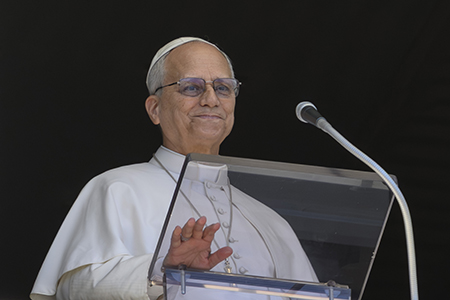
Pope Leo XIV smiles while leading the “Regina Caeli” prayer in St. Peter’s Square at the Vatican April 6, 2026. Pope Leo paid tribute to Pope Francis and called on Catholics to follow the late pontiff’s example in proclaiming the truth in a troubled world. (OSV News photo/Elisabetta Trevisan, Vatican Media)
The two contrasting narratives, he explained, are an invitation to reflect “on the value of Christian witness and the integrity of human communication.”
“Often, the proclamation of truth is obscured by what we today call ‘fake news’ – lies, insinuations, and unfounded accusations. Yet, in the face of such obstacles, the truth does not remain hidden; rather, it comes forth to meet us, living and radiant, illuminating even the deepest darkness.”
Like he told the women at the tomb, Jesus calls on Christians not to be afraid and to announce the good news of his resurrection.
“The Passover of the Lord is our Passover – the Passover of all humanity – for this man who died for us is the Son of God, who gave his life for us,” the pope said. “Just as the risen One, ever living and present, frees the past from a destructive end, so the Easter proclamation redeems our future from the tomb.”
Pope Leo emphasized the importance of the Gospel’s reach to “those oppressed by the evil that corrupts history and confuses consciences,” particularly those “afflicted by war, of Christians persecuted for their faith, of children deprived of an education.”
“To proclaim the Paschal mystery of Christ in both word and deed means to give a new voice to hope – a hope otherwise stifled by the hands of the violent. Wherever it is proclaimed, the Good News sheds light upon every shadow, in every age,” the pope said.
After praying with the faithful, Pope Leo expressed his gratitude for the prayers from those who “have sent me messages of good wishes for Easter during these days.”
“I hope you spend this Easter Monday and these days of the Easter Octave – during which we continue to celebrate Christ’s Resurrection – in joy and faith,” he said. “Let us continue to pray for the gift of peace for the whole world.”
(Junno Arocho Esteves is an international correspondent for OSV News. Follow him on X @jae_journalist.)
By Staff Reports SPRINGFIELD, Ill. – Women who are discerning a call to religious life as Dominican Sisters are invited to Mr. Lincoln’s Hometown in June for a national event hosted by the Springfield Dominican Sisters.
Applications are being received now, and up to fifteen women will be selected for participation in the event, scheduled for June 16-20. The group will live at Sacred Heart Convent and experience the rhythms of apostolic religious life, which includes community life, prayer, active service, and theological reflection. Any single Catholic woman age 20-45 who would like to participate is encouraged to apply at springfieldop.org/events.
Local non-profit organizations will provide sites for service activities.
Three additional congregations of Dominican Sisters are also participating: The Dominican Sisters of Adrian, Mich., the Dominican Sisters of Sinsinawa, Wis., and the Dominican Sisters of Peace, Columbus, Ohio, are co-sponsoring the project. Vocation ministers from each congregation will be present to the participants and animate group activities. Vocation ministers are those who accompany women discerning God’s call to religious life.
“Springfield is a perfect place to give women a taste of the foundations of Dominican life: community life, prayer, study, and preaching, or service.” said Sister Denise Glazik, OP, minister of vocation accompaniment for the Springfield Dominican Sisters. “Our senior sisters at the motherhouse are gracious and welcoming, and the city is home to some stellar nonprofit organizations that will provide a wonderful immersion experience for participants.
“All single Catholic women, 20-45 are welcome to apply – but do it soon!” Sister Denise added. There is a limit to the number of participants who can come.
The $50 participation fee should not be a barrier for any applicant. Scholarships will be available for those who need them.
Why Dominican Life? The Dominican Sisters hosting the 2026 Summer Immersion Experience are part of a worldwide Dominican family, the Order of Preachers. For more than 800 years, Dominicans have preached the Gospel in word and deed. Today, thousands of Dominican sisters, nuns, priests, brothers, associates and laity minister in more than 100 countries around the world. To learn more about the U.S. Dominicans visit dominicansistersconference.org.
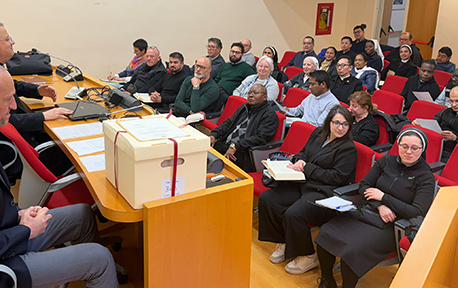
ROME – Boxes containing the collected works and testimonies for the cause of Sister Thea Bowman are opened at the Dicastery for the Causes of Saints on March 18.
On March 18, the Diocese of Jackson received confirmation that Sister Thea’s boxes had arrived at the Dicastery for the Causes of Saints and were officially opened by dicastery officials as part of a studium (class) teaching canon law students about the canonization process. Sister Thea is still teaching even in death.
Normally, it takes several months after arrival for the boxes to be scheduled for an official opening, but Sister Thea’s boxes arrived and two weeks later they are open.
The next step is to receive a decree of validity from the dicastery, which verifies that all the documents are in order and the process has been followed. Once this decree is received by our postulator, Emanuele Spedicato, the hard work of writing the “positio” or position paper will begin in earnest.
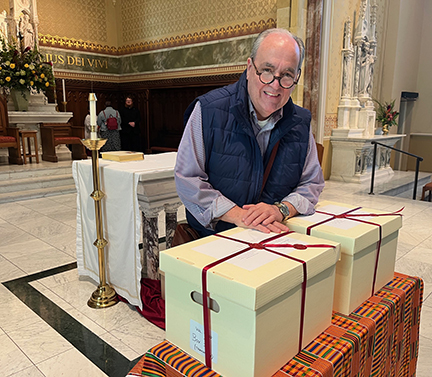
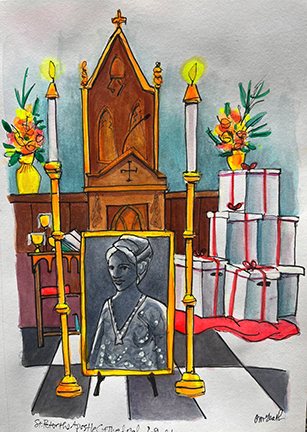
Brother Mickey McGrath, OSFS, with the boxes containing his paintings of Sister Thea Bowman, which were sent to Rome to support her cause for canonization. Below is a a sketch he completed during the Mass for Sister Thea’s cause for canonization at the Cathedral of St. Peter in Jackson on Feb. 9, 2026. (Photos courtesy of Brother Mickey McGrath)
By Francesca Pollio Fenton (EWTN News) – Nearly 30 years ago, Brother Mickey McGrath, OSFS, an award-winning artist, found himself in a hospital room as his father battled colon cancer. One afternoon he came across a magazine and in it was the last interview with Servant of God Sister Thea Bowman – an African American woman who challenged the Church in the 20th century to confront its history of racial exclusion and to embrace Black Catholics through her work as a scholar, teacher and speaker.
“I had never heard of the woman in my life, but I read this article right there on the spot and I thought, ‘Wow, she was something. How did I miss her all this time,’” McGrath told EWTN News.
“Music was at the very heart of her whole ministry,” he added. “And so, that struck me too as an artist, that she was using her artistic gifts to advance her spirit.”
One year later, McGrath welcomed a couple of brothers into his home who were preparing to take their final vows. Together they watched a video on Bowman that left him “energized and inspired.”
“The next morning, I got up and started painting and I didn’t stop for two weeks,” he said. “And in two weeks’ time I had nine paintings in a style very different from anything I had ever done before … It was like I was touching things that were already deep in me, you know, spiritually, but I didn’t have access to.” Now McGrath has 47 paintings inspired by Bowman that have been packaged into boxes and sent to Rome for review to advance her cause for canonization.
The diocesan phase of Bowman’s cause for canonization was officially closed by the Diocese of Jackson, on Feb. 9. McGrath attended the Mass for this occasion, which was celebrated by Bishop Joseph Kopacz and held in the Cathedral of St. Peter the Apostle in Jackson. He called it a “truly wonderful event.”
Reflecting on his paintings, McGrath said one stands out among the rest: a painting titled “This Little Light of Mine.” A painting from his first nine paintings inspired by Bowman – which he calls “the spirituals” – this painting depicts Bowman in a green habit holding a monstrance up in the air. He explained that it connects the classic song with “the light of Christ.”
McGrath shared that Bowman continues to provide Catholics with an important message today: “We’re all made in the image and likeness of God, and that’s got to be preeminent.”
Bowman, born in 1937, was a trailblazing Catholic sister, educator, and evangelist. A member of the Franciscan Sisters of Perpetual Adoration, she converted to Catholicism as a child and later became one of the most compelling advocates for Black Catholic spirituality in the United States.
With a gift for storytelling, Bowman traveled the country speaking, singing, and teaching – urging the Church to embrace the cultural gifts of African American Catholics.
In 1989, despite battling cancer, Bowman addressed the U.S. bishops with a now-famous speech that blended gospel song, humor and a prophetic call for unity. Her witness left a lasting impression, and in 2018 her cause for canonization was formally opened by the Diocese of Jackson, giving her the title “servant of God.”
(This article is reprinted with permission from EWTN News. Visit bromickeymcgrath.com for more on the artwork of Brother Mickey McGrath.)
GREENWOOD – Locus Benedictus, Inner Healing Retreat, April 25 from 8:30 a.m. to 3 p.m. Details: (662) 299-1232.
HOLLY SPRINGS – Catholic Parishes of Northwest MS, Ladies Group Retreat, Saturday, April 25 from 9 a.m. to 5 p.m. at Gregory House, with a talk by Sisters Leonora and Susan. Sign up by April 19. Details: church office (662) 342-1073.
PILGRMAGE – Travel with Father Carlisle Beggerly to Italy/Greece, Oct. 7-20, 2026. Cost: $5,999 per person. Details: Contact Proximo Travel (855-842-8001) or visit proximotravel.com (enter Fr. Carlisle in search box).
Travel with Father Raju Macherla to Portugal, Spain and France, July 6-17, 2026. Cost: $5,500 per person (sharing room), with departure from Memphis. Details: visit https://bit.ly/4efWoql.
PARISH & YOUTH EVENTS FLOWOOD – St. Paul, Calling all Catholic Homeschoolers! We are forming a Catholic Homeschool co-op, join us for Mass and an interest meeting, Friday, May 1 at 10 a.m. Bring lunch for your family for a picnic following Mass. Details: lumenmundihs@gmail.com.
GREENWOOD – Immaculate Heart of Mary, CYO Bingo Night Fundraiser, Wednesday, April 22, in the parish center. Games at 6 p.m., doors open at 5:30 p.m. Cost: $40 at the door for one card for all 10 games. $5 burger meals available. Details: office (662) 453-3980.
HERNANDO – Holy Spirit, Annual Yard Sale, Friday, April 24 from 10 a.m. to 5 p.m. and Saturday, April 25 from 8 a.m. to 1 p.m. Details: Tena at (901) 598-7927.
JACKSON – St. Richard, Special Kids Art Show, Thursday, April 23 from 6-7:30 p.m. in Foley Hall. Details: call (601) 366-2335.
MADISON – St. Francis, Luella and Floyd Q. Doolittle Golf Tournament, Friday, May 8 at Whisper Lake Country Club. Fun costests begin at noon and a shotgun start at 1 p.m. An awards presentation and a home-cooked meal by KC 9543 will take place in the clubhouse after all participants have cleared the course. Details: Tunney at (601) 622-4145 or tunneyv1@icloud.com.
St. Francis of Assisi, Cajun Fest, Sunday, May 17 from 12-4 p.m. Details: church office (601) 856-5556.
CORRECTION Lewis and Dinah Slay of Sacred Heart parish in Greenville are recipients of the Bishop Chanche Medal for Service this year. The couple were inadvertently left off the list in the last edition of Mississippi Catholic. We apologize for the error.
A view of Earth, partially hidden by the moon, is photographed through the Orion spacecraft window at 6:40 p.m. EDT (22:40 GMT) April 6, 2026, just four minutes before the Orion spacecraft and its crew went behind the moon and lost contact with Earth for 40 minutes before emerging on the other side during the Artemis II crew’s flyby of the moon. (OSV News photo/NASA handout via Reuters)
NATION HOUSTON (OSV News) – As the astronauts of NASA’s first crewed lunar flyby in half a century reached their closest approach to the moon, the team’s pilot reminded the Earth of Jesus Christ’s command to love both God and neighbor. “As we get close to the nearest point to the moon and farthest point from Earth, … I would like to remind you of one of the most important mysteries there on Earth, and that’s love,” said astronaut Victor Glover, pilot of the Artemis II mission, speaking to ground control April 6 from aboard NASA’s Orion spacecraft Integrity. “Christ said, in response to what was the greatest command, that it was to love God with all you are,” said Glover. “And he also, being a great teacher, said the second is equal to it. And that is to love your neighbor as yourself.” The call for unity by Glover, who has spoken publicly about his Christian faith, took on an immediate urgency as the crew faced a 40-minute communication lapse with ground control April 6, when the spacecraft passed behind the moon, blocking signals. Moments before the loss of signal – which ended as scheduled, with the crew safely emerging on a homeward bound trajectory – Glover said, “As we prepare to go out of radio communication … to all of you down there on Earth and around Earth, we love you from the moon.”
VATICAN CASTEL GANDOLFO, Italy (OSV News) – Pope Leo XIV asked all people of goodwill to search always for peace and not violence, in a tacit rebuke of President Donald Trump’s threat that a “whole civilization will die tonight” if Iran does not make a deal by 8 p.m. EDT on April 7. Without naming Trump, Pope Leo called the threat “truly unacceptable,” addressing it as a moral question that affects the good of an entire people. He added that he wanted to remind all involved that “attacks on civilian infrastructure is against international law.” Such attacks, he added, are a sign of “the hatred, the division and the destruction that the human being is capable of.” “And we all want to work for peace, people want peace,” Pope Leo said. “I would invite the citizens of all the countries involved to contact the authorities, political leaders, congressmen, to, ask them, tell them to work for peace and to reject war.” Earlier April 7, in a post on his social media website, Truth Social, Trump said, “A whole civilization will die tonight, never to be brought back again. I don’t want that to happen, but it probably will.” Pope Leo said that due to the Iran war, which “many people have said is an unjust war,” there is “a worldwide economic crisis, energy crisis,” and a “situation in the Middle East of great instability, which is only provoking more hatred throughout the world.” He said, “Let’s talk, let’s look for solutions in a peaceful way.”
WORLD LOURDES, France (OSV News) – After 17 years at the helm of Lourdes’ medical investigations, Italian American physician Alessandro de Franciscis retired as head of the sanctuary’s Office of Medical Observations. He will be succeeded by Italian surgeon Giada Monami, who will become the first woman to hold the post. Appointed in 2009 as the first non-French chief physician, de Franciscis oversaw the rigorous evaluation of reported healings at the Marian shrine. “Our role as doctors is solely to determine whether a person has been cured, and whether that cure is unexplained given the current state of scientific knowledge,” he said, noting that the Church alone judges miracles. Since 1883, tens of thousands of healings have been reported at Lourdes, but only a fraction undergo detailed review. Strict criteria require verified diagnosis, sudden and lasting recovery, and extensive follow-up. Of roughly 8,000 recorded cases since 1858, just 72 have been recognized as miracles. De Franciscis, the bureau’s 15th physician, said five miracles were confirmed during his tenure.
CHICAGO (OSV News) – Easter Triduum visits ended the Lenten season for a small group of Chicago-area religious and clergy who ministered to people in the U.S. without legal authorization that are detained at an Immigration and Customs Enforcement facility.
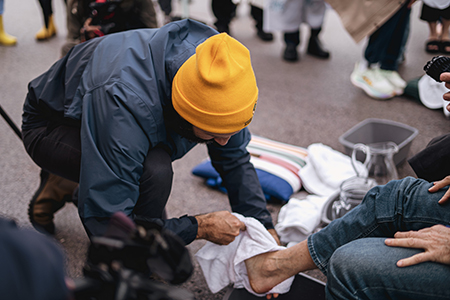
Michael Okinczyc-Cruz, executive director of the Coalition for Spiritual and Public Leadership, washes the feet of an immigrant on Holy Thursday, half a block away from the Broadview ICE processing facility in Broadview, Ill., as three priests and a religious sister minister to 14 people detained at the ICE facility April 2, 2026. (OSV News photo/courtesy of Coalition for Spiritual and Public Leadership)
The same group started the 40-day period of preparation for the Lord Jesus Christ’s passion, death and resurrection with an Ash Wednesday visit to the processing facility in Broadview, Illinois, to bring holy Communion, give ashes and pray with those Catholics being held there.
The visits during the Church’s most sacred period of the year were a result of court orders that compelled the Department of Homeland Security to allow access to members of the Coalition for Spiritual and Public Leadership. Last year, the Chicago-based Catholic social justice organization tried several times to enter the ICE processing unit but it was turned away each time.
Jesuit Father David Inczauskis was part of the CSPL team of three priests and a religious sister who went inside the Broadview facility on Holy Thursday, April 2.
On April 6, Easter Monday, he told OSV News he was struck when the group first saw those being brought for processing in handcuffs and ankle shackles.
It was the first time Father Inczauskis had encountered detainees in shackles. He has done prison and jail ministry in Peru and Honduras, and also ministered to minors in the U.S. who had been separated from their parents.
“I think to see this was unique, and particularly devastating and dehumanizing,” he said.
Father Inczauskis and another priest who spoke with OSV News described the setting for the pastoral visits. They said the small delegation prayed, read Scripture and gave Communion through a half door in what they described as an “intersection between two long hallways” separated by the door that opened in two halves. They said the 14 people they ministered to on Holy Thursday were brought to the door in two sets of five, and then four.
On the other days of the Triduum, there were far fewer detainees to minister to, sometimes just one or two, they added.
One priest was allowed to wash the shackled feet of the detainees after Father Inczauskis read the Holy Thursday Gospel on the Last Supper. In the reading, Jesus washed the feet of his disciples before going to the Garden of Gethsemane to pray, where he was then arrested.
The superior of the Claretians’ USA-Canada province, Father Paul Keller, led prayers and the opening and closing blessings. Also on Easter Monday, he described the same look of “shock and disorientation” on the detainees’ faces that he recognized when he was last inside the facility on Ash Wednesday. He noted they were within the very first minutes and hours of being brought in.
“Some people really broke down,” he said. “It was a moment in which they perhaps let out the sadness and frustration that they had been feeling.”
“But then also I got the sense that some of them took the foot washing as a sign of care and humanity in a situation of such dehumanization that this allowed them to experience those emotions of being cared for in this time of great distress,” he told OSV News.
The processing facility is located in Broadview, a suburb about 12.5 miles west of Chicago’s downtown. It was a flashpoint for heated clashes between protesters and ICE personnel at the height of the Trump administration’s immigration crackdown.
CSPL sued for access to the facility in November last year, citing violations of their rights to freely exercise their religion under the First Amendment, the Religious Freedom Restoration Act and the Religious Land Use and Institutionalized Persons Act.
OSV News requested comments from DHS on the recent visits and has not yet received a response.
Among migrants most at risk of arrest and deportation by ICE about 80% are Christian — the majority of them (61%) are Catholic — according to a joint Catholic-evangelical report published by World Relief and the U.S. Conference of Catholic Bishops.
U.S. District Judge Robert W. Gettleman of the Northern District of Illinois ordered a preliminary injunction to allow members of CSPL to give ashes and Communion on Ash Wednesday. He also ordered both sides to work out a schedule for future visits and allow religious and lay ministers to once again pray outside the Broadview facility, like they did for years until the immigration crackdown intensified.
In the partial injunction issued March 31 that forced the Triduum visits, Gettleman wrote, “The court finds that the government has substantially burdened plaintiffs’ exercise of religion.”
He noted, “The court also agrees with plaintiffs that the injunction is in public interest. Allowing plaintiffs to provide pastoral care to migrants and detainees will improve the condition of those detained at Broadview.”
Gettleman reiterated the need for both sides to schedule further, regular visits and prayer just outside Broadview facility, within view of the detainees. A status hearing was scheduled for April 7.
Michael Okinczyc-Cruz, CSPL’s executive director, told OSV News the Triduum and Easter visits were a “profoundly moving and stirring experience … for not only our ministers who entered, but the communities that surrounded those ministers with prayer.”
“And for our siblings, who are detained and their families,” he said, “it brought some comfort and consolation in a period of profound darkness.”
(Simone Orendain is an OSV News correspondent. She writes from Chicago.)
(OSV News) – Drawing inspiration from St. Carlo Acutis, a national shrine in Wisconsin is inviting Catholics to celebrate the 250th anniversary of the United States this summer by joining in prayer and learning about the holy men and women of America.
“They founded schools, cared for the sick, served the poor, and witnessed to the Gospel through lives of sacrifice, service and unwavering love for Jesus Christ,” said Father of Mercy Anthony Stephens, rector of the National Shrine of Our Lady of Champion. “Their example shows us what it truly means to be a faithful Catholic and to be American.”
Scheduled for July 1-9, “Catholic Saints of America” will feature a special novena, an exhibit honoring Americans who are saints or on the path to sainthood, and an opportunity to venerate their relics. The relics or remains of St. Elizabeth Ann Seton, Blessed Solanas Casey and Blessed Stanley Rother will be among those on display.
A worshipper venerates the Jubilee Mission Cross used during a 2025 Jubilee Year procession at the National Shrine of Champion in Champion, Wis., July 20. Jesuit Father Francis Xavier Weninger, a pastor to German Catholics in Green Bay in the 1800s, erected mission crosses in each parish he visited, including the one used for the procession. The cross is inscribed with the message: “He who perseveres will be blessed forever.” (OSV News photo/Sam Lucero)
All this is taking place on the site of the only Church-approved Marian apparition site in the United States.
“First, through this novena and exhibit, we hope people will come to learn about the canonization process,” Father Stephens told OSV News. “Next, we want to help people discover those who may one day be declared saints. Finally, we can help introduce people to a new devotion that inspires them to grow closer to Christ.”
The novena prayer, which Father Stephens is writing, will seek Mary’s intercession for unity, holiness and renewal nationwide. Alongside the novena, the exhibit will feature the stories of holy men and women of America. It will highlight their lives, virtues and legacy, organizers said.
Its format was inspired by a traveling Eucharistic miracles exhibit, which was based on a website created by St. Carlo Acutis, an Italian teenager canonized last year.
“There are fewer than 15 American saints, and only a little more than 70 people whose causes (for sainthood) have been opened” in the U.S., Father Stephens said. “Each of these holy men and women has a beautiful story and powerful example, yet so few people know about them.”
“We do not have saints from 2,000 years ago; we have saints of today,” he added. “This shows that God is still at work, calling people to himself.”
Americans who have been canonized are Sts. Elizabeth Ann Seton, John Neumann, Marianne Cope, Katharine Drexel, Damien de Veuster of Molokai, Junípero Serra, Kateri Tekakwitha, Théodore Guérin, Frances Xavier Cabrini and Rose Philippine Duchesne. St. Teresa of Kolkata was given honorary American citizenship in 1996, the year before she died.
Beatified Americans include Blesseds Miriam Teresa Demjanovich, Stanley Rother, Solanus Casey, Michael J. McGivney, Francis Xavier Seelos and Carlos Manuel Cecilio Rodríguez Santiago of Puerto Rico. Five Franciscan friars known as the Georgia martyrs will join them Oct. 31, and the beatification of Archbishop Fulton Sheen is also expected soon.
The shrine is in the process of inviting promoters of all U.S. causes to participate. So far, the promoters of more than 35 causes have confirmed they will collaborate in some way. Some will help create their respective exhibit displays, and many will attend in person, Father Stephens said.
While the novena and exhibit take place July 1-9, many of the promoters and representatives of these causes will be present July 3-5. For those days, guest speakers will also “engage with pilgrims, share the stories of these holy men and women, and provide opportunities to learn more about the path to sainthood in America,” said Kim May, the shrine’s event and volunteer coordinator.
Organizers expect that more than 15,000 pilgrims could attend, which would make this the largest event hosted by the shrine.
The exhibit will recognize in a special way the cause of Servant of God Adele Brice, a Belgian immigrant who reported seeing the Blessed Virgin Mary three times in 1859. She is buried at the shrine, which marks the site where they met. The cause for her sainthood opened in January.
Mary, as she appeared to Brice (sometimes also spelled “Brise”), is honored under the title of “Our Lady of Champion” for the nearby town of Champion, 15 miles northeast of Green Bay.
Father Stephens, who as the shrine’s rector serves as the actor or promoter of Brice’s cause, said the upcoming event will mark the 130th anniversary of the catechist’s death July 5.
The shrine plans to celebrate Mass that day at 11:30 a.m. local time to pray for Brice’s cause for canonization and for her continued intercession, he said.
“The afternoon will include guest speakers representing sainthood causes and catechetical presentations, continuing the mission Our Lady entrusted to Adele to teach the faith and lead souls to salvation,” he said.
The shrine will also host a picnic that day. In addition to Mass and speakers, videos and educational presentations will highlight America’s holy women and men.
The shrine, May said, is entrusting the event to the patronage of Mary under her titles of Our Lady of Guadalupe, patroness of the Americas; the Immaculate Conception, patroness of the United States; and Our Lady of Champion.
The all-age event will include interactive activities for families. The shrine will offer history scavenger hunts, children’s activity pages and more.
“Our hope,” May said, “is that families will come together to celebrate this historic moment, learn about the holy men and women who shaped our nation, and be inspired to grow in faith.”
(Katie Yoder is an OSV News correspondent. She writes from Maryland.)
Únase a lista de correos electrónicos Mande un texto: MSCATHOLIC a 84576
LÍNEA DIRECTA DE PREVENCIÓN DE FRAUDE
El Departamento de Asuntos Temporales de la Diócesis de Jackson ha contratado a Lighthouse Services para proporcionar una línea directa anónima de fraude financiero, cumplimiento, ética y recursos humanos. Esta línea directa permite un método adecuado para reportar sucesos relacionados con la administración temporal dentro de parroquias, escuelas y la oficina de cancillería.
Una imagen de la Tierra, parcialmente oculta por la Luna, tomada el 6 de abril de 2026 durante el sobrevuelo lunar de la tripulación de Artemis II. (Foto de OSV News/Cortesía de la NASA vía Reuters)
NACIÓN HOUSTON – NASA en sobrevolar la Luna en medio siglo alcanzaron su punto de máxima aproximación a la Luna, el piloto del equipo recordó a la Tierra el mandamiento de Jesucristo de amar tanto a Dios como al prójimo. “A medida que nos acercamos al punto más cercano a la Luna y al más alejado de la Tierra, … “Me gustaría recordarles uno de los misterios más importantes que hay en la Tierra, y ese es el amor”, dijo el astronauta Victor Glover, piloto de la misión Artemis II, al dirigirse al control de tierra el 6 de abril desde a bordo de la nave espacial Orion Integrity de la NASA. “Cristo dijo, en respuesta a cuál era el mandamiento más importante, que era amar a Dios con todo tu ser”, dijo Glover. “Y él también, siendo un gran maestro, dijo que el segundo es igual a este. Y ese es amar a tu prójimo como a ti mismo”. El llamado a la unidad de Glover, quien ha hablado públicamente sobre su fe cristiana, adquirió una urgencia inmediata cuando la tripulación enfrentó una interrupción de 40 minutos en la comunicación con el control de tierra el 6 de abril, cuando la nave espacial pasó detrás de la Luna, bloqueando las señales. Momentos antes de la pérdida de señal —que terminó según lo previsto, con la tripulación emergiendo a salvo en una trayectoria de regreso a casa—, Glover dijo: “Mientras nos preparamos para salir de la comunicación por radio… a todos ustedes allá abajo en la Tierra y alrededor de la Tierra, los amamos desde la Luna”.
VATICANO CASTEL GANDOLFO, Italia (OSV News) – El papa León XIV pidió a todas las personas de buena voluntad que busquen siempre la paz y no la violencia, en una reprimenda tácita a la amenaza del presidente Donald Trump de que “toda una civilización morirá esta noche” si Irán no llega a un acuerdo antes de las 8 p. m. EDT del 7 de abril. Sin nombrar a Trump, el papa León calificó la amenaza de “verdaderamente inaceptable”, abordándola como una cuestión moral que afecta al bien de todo un pueblo. Añadió que quería recordar a todos los involucrados que “los ataques contra la infraestructura civil van en contra del derecho internacional”. Tales ataques, añadió, son una señal del “odio, la división y la destrucción de que es capaz el ser humano”. “Y todos queremos trabajar por la paz, la gente quiere la paz”, dijo el papa Leo. “Invitaría a los ciudadanos de todos los países involucrados a ponerse en contacto con las autoridades, los líderes políticos y los congresistas para pedirles y decirles que trabajen por la paz y rechacen la guerra”. Más temprano el 7 de abril, en una publicación en su red social, Truth Social, Trump dijo: “Toda una civilización morirá esta noche, para no volver jamás. No quiero que eso suceda, pero probablemente sucederá”. El papa León dijo que debido a la guerra de Irán, que “muchas personas han calificado de injusta”, existe “una crisis económica mundial, una crisis energética” y una “situación de gran inestabilidad en Oriente Medio, que solo está provocando más odio en todo el mundo”. Dijo: “Hablemos, busquemos soluciones de manera pacífica”.
MUNDO LOURDES, Francia (OSV News) – Tras 17 años al frente de las investigaciones médicas de Lourdes, el médico italoamericano Alessandro de Franciscis se jubiló como director de la Oficina de Observaciones Médicas del santuario. Le sucederá la cirujana italiana Giada Monami, quien se convertirá en la primera mujer en ocupar el cargo. Nombrado en 2009 como el primer médico jefe no francés, de Franciscis supervisó la rigurosa evaluación de las curaciones reportadas en el santuario mariano. “Nuestro papel como médicos es únicamente determinar si una persona ha sido curada y si esa curación es inexplicable dado el estado actual del conocimiento científico”, dijo, señalando que solo la Iglesia juzga los milagros.