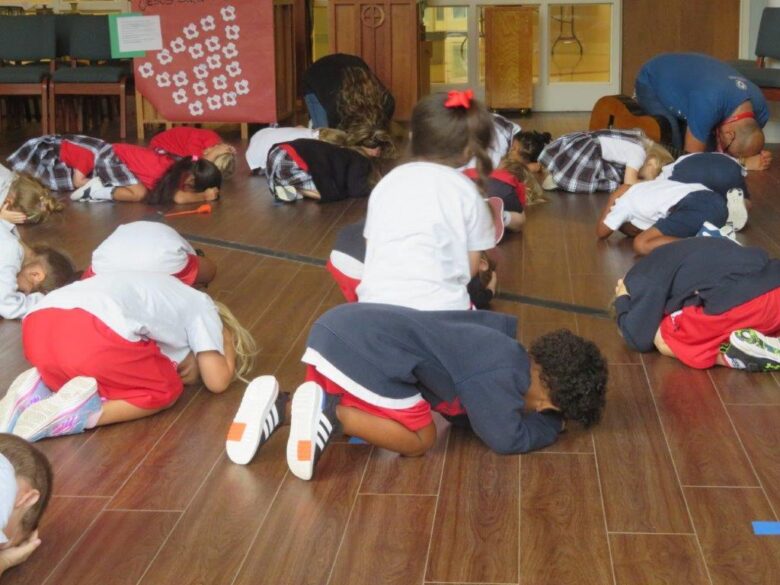
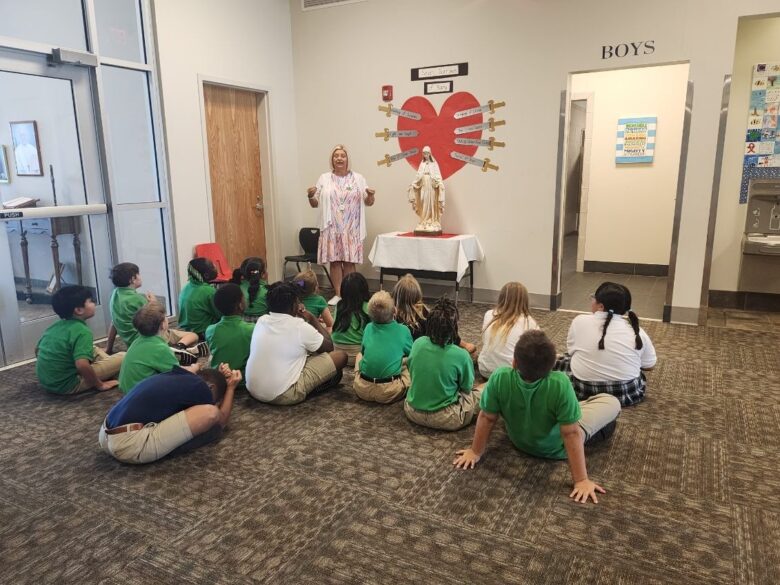
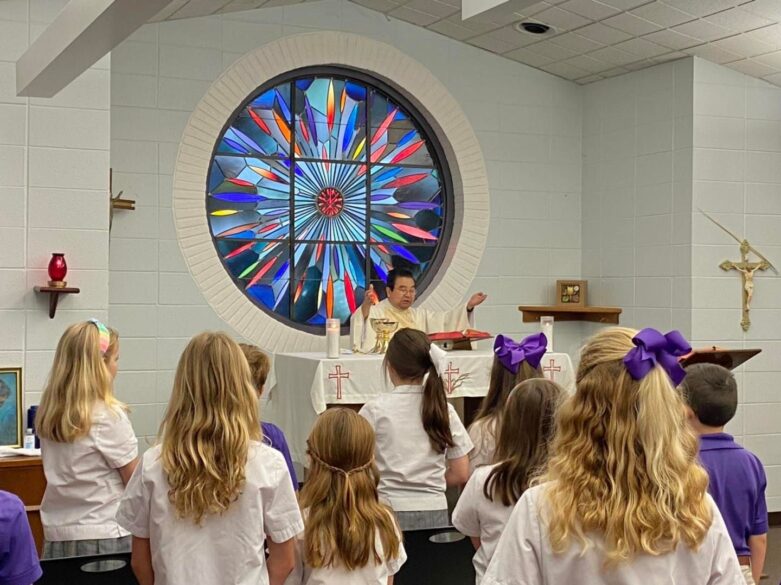
SOUTHAVEN – Sacred Heart PreK students took part in a prayer service on the Feast of the Nativity of the Blessed Virgin Mary with Brother Diego. (Photo by Sister Margaret Sue Broker)MERIDIAN – St. Patrick third graders learn about the Seven Sorrows of Mary. (Photo by Owen Kasey)
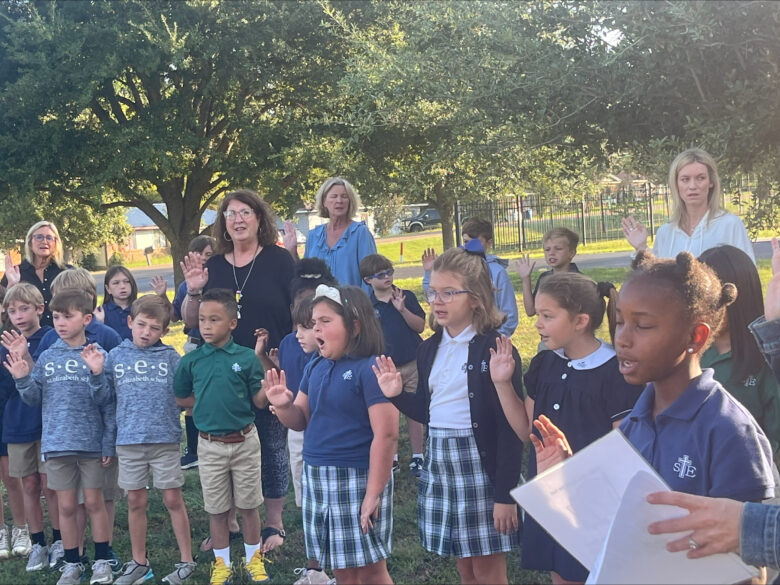
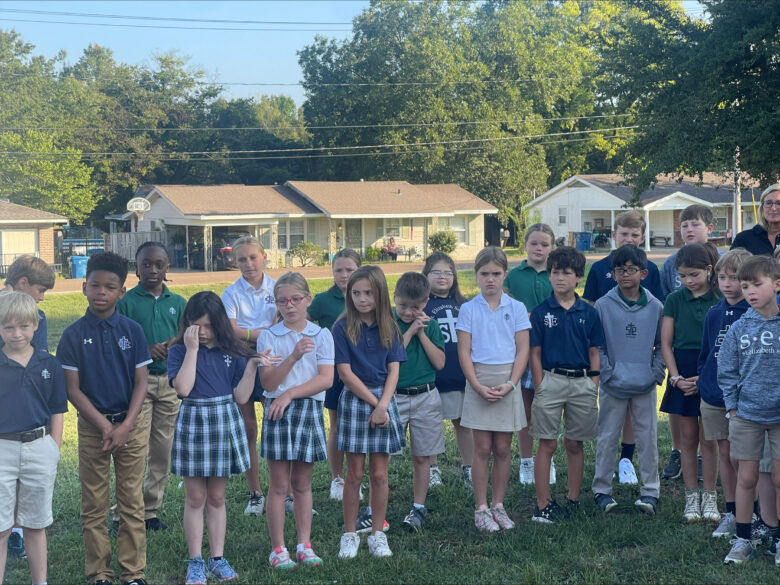
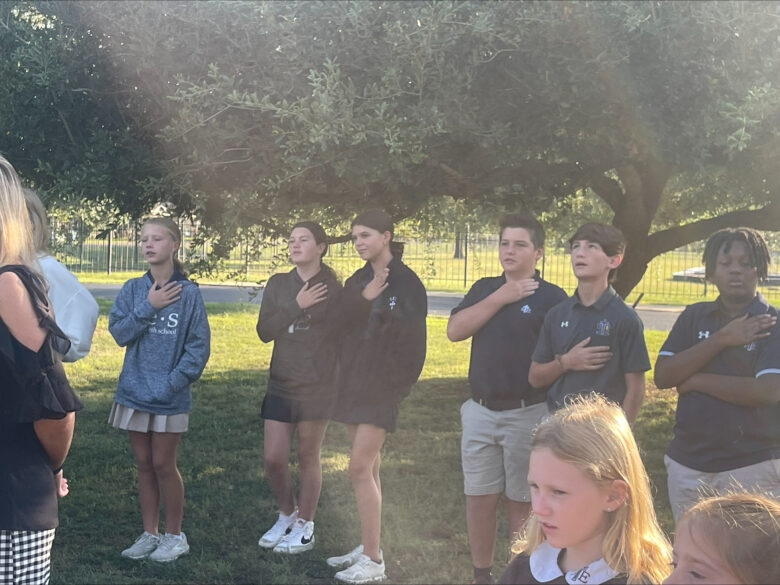
CLARKSDALE – St. Elizabeth students joined around the flagpole for a prayer service in honor and memory of Patriot Day – Sept. 11, 2001. (Photo by Mary Evelyn Stonestreet)
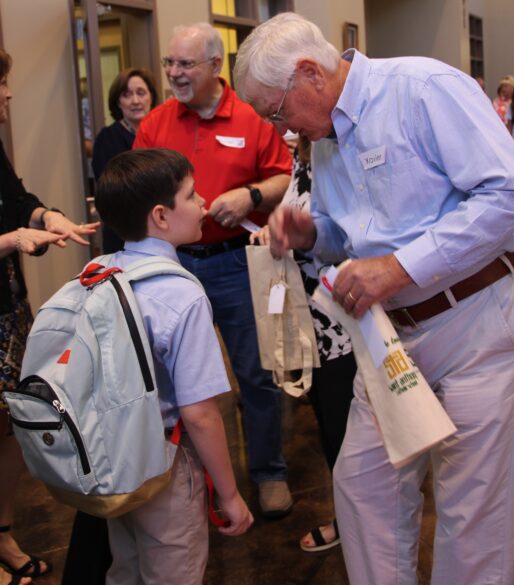
MADISON – Brooks Holder speaks with his grandfather during the Grandparents’ Day celebration at St. Anthony School on Friday, Sept. 15. (Photo by Celeste Tassin)
School sports
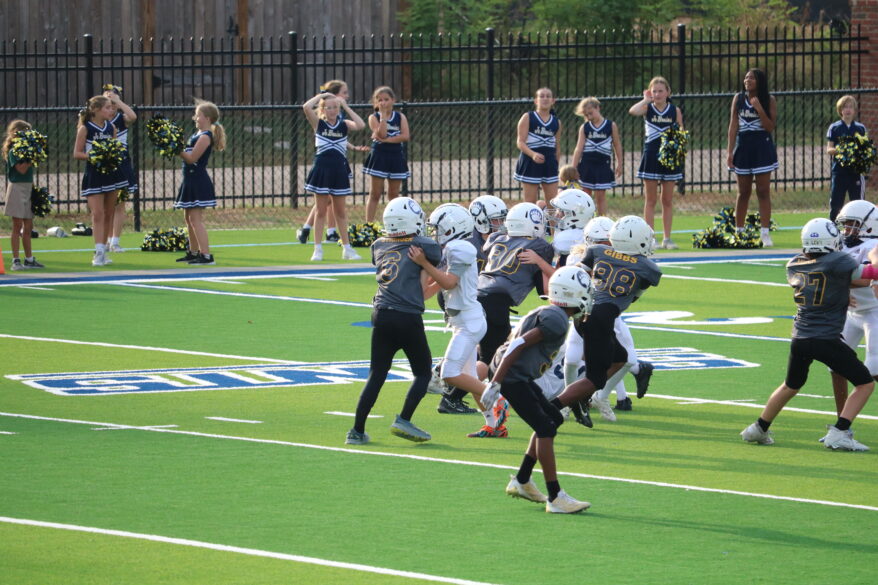
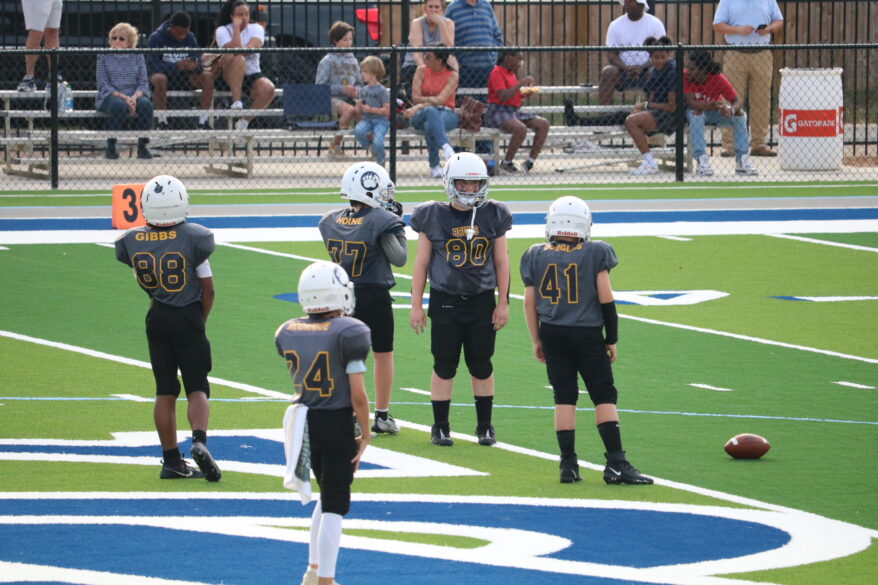
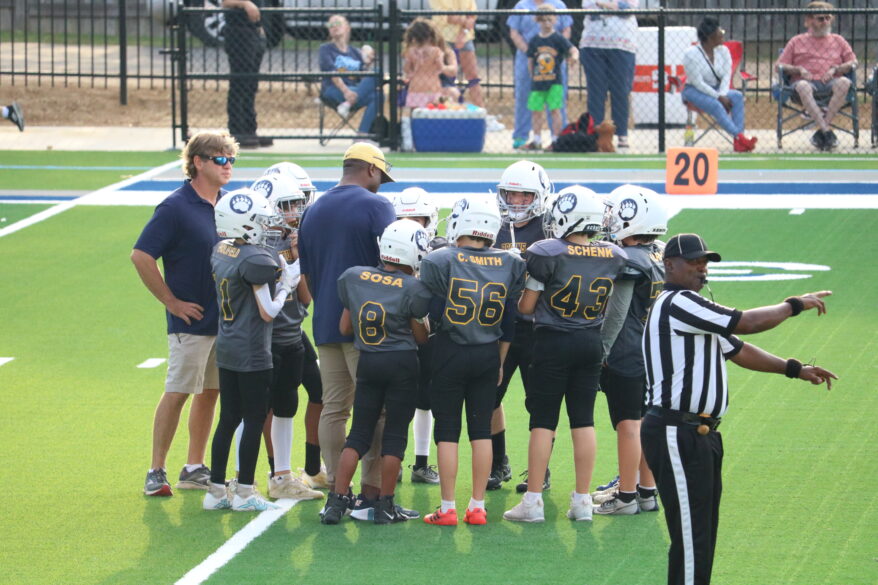
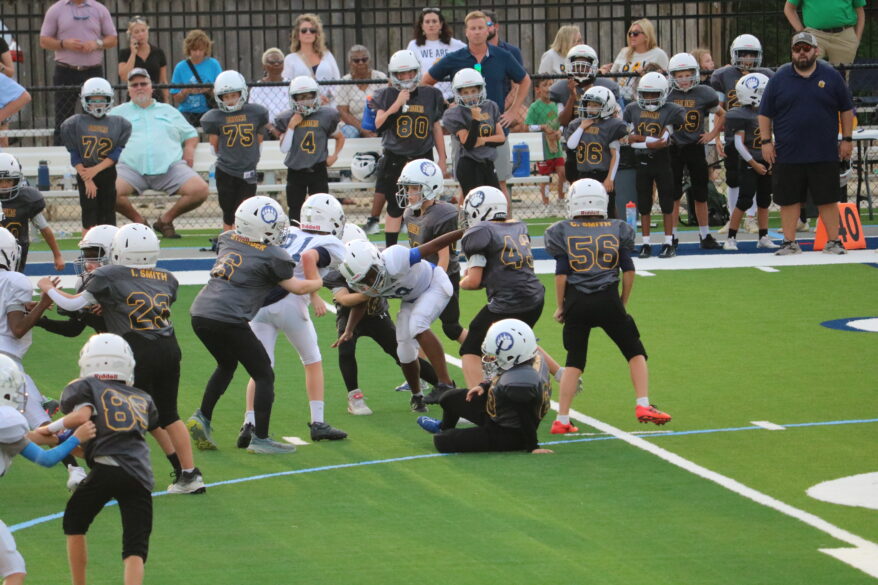
Jr. Bruins Football versus St. Andrew’s Saints 9.14.23Jr. Bruins Football versus St. Andrew’s Saints 9.14.23Jr. Bruins Football versus St. Andrew’s Saints 9.14.23Jr. Bruins Football versus St. Andrew’s Saints 9.14.23
RIDGELAND – The Junior Bruins, made up of students from St. Anthony and St. Richard students, rolled over the St. Andrew’s Saints with a 28 to zero victory on Thursday, Sept. 14. (Photos by Joanna Puddister King)
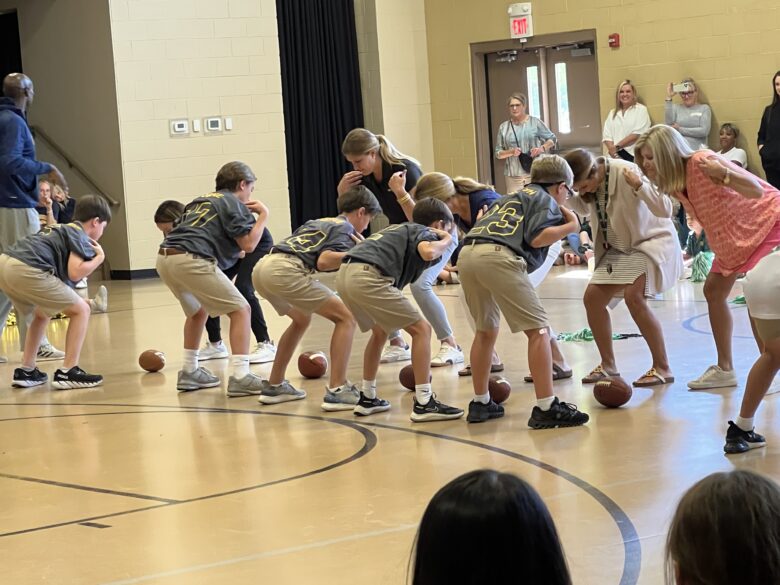
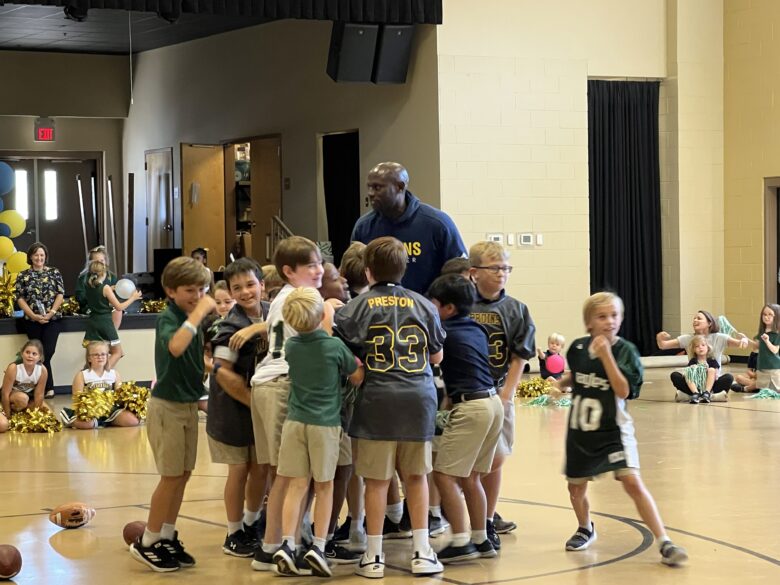
Coach Dwyane Demmin leads a game of skill at the St. Anthony School pep rally on Tuesday, Sept. 19. Who will be the fastest in the school?Coach Dwyane Demmin leads a game of skill at the St. Anthony School pep rally on Tuesday, Sept. 19. Who will be the fastest in the school?Coach Dwyane Demmin dances with cheerleaders at the St. Anthony School pep rally on Tuesday, Sept. 19.
MADISON – Coach Dwyane Demmin challenged several teachers and student athletes to find out who is the fastest in the school at a pep rally on Tuesday, Sept. 19 at St. Anthony School. (Photos by Joanna Puddister King)
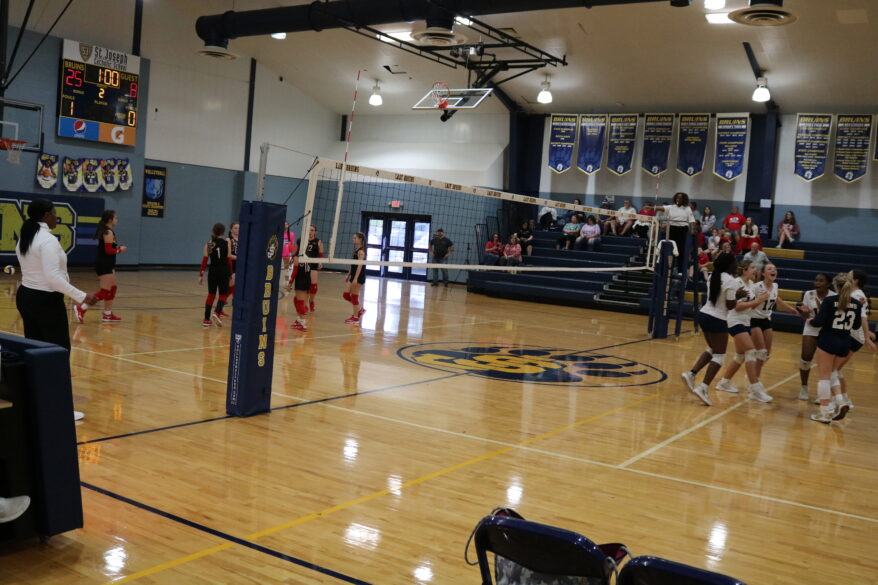
MADISON – The St. Joseph Lady Bruins middle school volleyball team celebrate their win of 25 – 8 over Simpson Academy on Thursday, Sept. 21. (Photo by Tereza Ma)
From the Archives By Mary Woodward JACKSON – This past June at the U.S. bishops’ annual spring meeting, the Diocese of Shreveport put forward the cause for canonization of five priests who had served and died there during the 1873 Yellow Fever epidemic. These men ministered to the sick and dying in and around Shreveport until succumbing to the dreaded fever themselves.
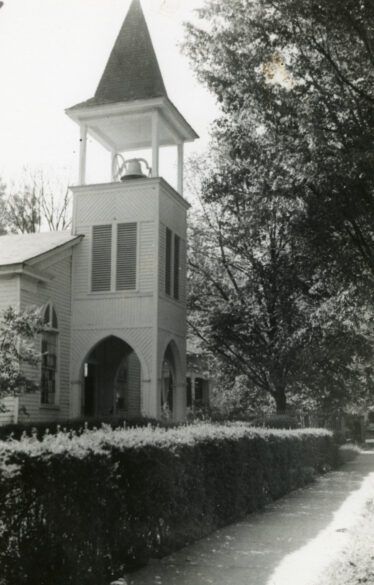
HOLLY SPRINGS – Archive photo of St. Joseph Catholic Church. Six Sisters of Charity along with the pastor died during the Yellow Fever epidemic of 1878 at the Marshall County church. Archivist, Mary Woodward gives an account of that time period in her latest “From the Archives” column.
I mentioned in the last installment of this series that our second bishop, James Oliver Van de Velde, died of Yellow Fever in 1855. Yellow Fever was a frequent visitor to the South in the 1800s.
Bishop William Henry Elder, our third bishop, contracted the fever but survived it. However, much like Shreveport, Bishop Elder lost six of his priests to the fever’s outbreak in 1878. From Aug. 31 – Sept. 14, 1878, the then Diocese of Natchez lost: Fathers Jean Baptiste Mouton (8/31), Patrick Cogan (9/8), John McManus (9/8), Anacletus Oberti (9/11), Charles Van Queckleberge (9/11) and John Vitolo (9/14).
In a letter from November 1878, Father Patrick Hayden writes Bishop Elder from Columbus lamenting the loss of the six men, especially Father Mouton, who was a trained architect and had designed several of the churches in the eastern half of the diocese, including the original church in Columbus.
Father Cogan was in Canton and was said to be the only remaining minister in the town when the outbreak occurred. An interesting note from a newspaper article reveals ministers of other denominations wanted to stay but were convinced to leave due to the fact that they had wives and children, who would be left destitute without them if they died. There is a monument for Father Cogan at Sacred Heart in Canton.
We must remember, though, that alongside these priests were fearless women religious – Sisters of Mercy and Sisters of Charity – Angels, who served as nurses to the sick and eventually themselves died. Rarely are these heroic women given names, but in the case of Holly Springs St. Joseph, we do have at least the first names of the six Sisters of Charity who died – Stanislaus, Stella, Margaret, Victoria, Lorentia and Corinthia.
Cleta Ellington in her masterwork “Christ the Living Water” written for the Diocese of Jackson’s 150th anniversary in 1988, gives a stirring account of the epidemic of 1878 in Holly Springs. It follows below along with the tribute given to Sister Corinthia Mahoney by an eyewitness account.
“In the late summer and early fall of 1878, yellow fever swept across Mississippi like a conquering army, but it appeared that Holly Springs was to be spared. The city fathers, in a burst of generosity and believing that the germ could not live in such a high and dry climate, opened the doors of the town to fever refuges from surrounding counties.
“Two articles from New Orleans newspapers reveal the swiftness with which the townspeople learned their leadership was in error.
“Aug. 13, 1878: ‘The town is clean and healthy…no symptoms of the outbreak here. We have thrown open our hospitality to our sister cities, even accepting Grenada where the fever rages. The mayor and the community council decided today to use disinfectants merely as a precautionary…’
“Aug. 19, 1878: ‘Yesterday there were seven deaths, last night six, five of whom died in our house. The situation is too appalling to be described and the worst is, not a single case has recovered or promises recovery.’
“The Marshall County Courthouse was turned into a hospital where beds were piles of straw, where black and white lay together to await medical treatment almost certainly useless.
“The 12 sisters at Bethlehem Academy closed the school and took over the courthouse hospital. They were joined by a number of volunteer doctors who had heroically rushed to the town and by Father Anacletus Oberti, a friendly Italian priest, 31 years old, who had been working very hard to establish a Catholic library at St. Joseph.
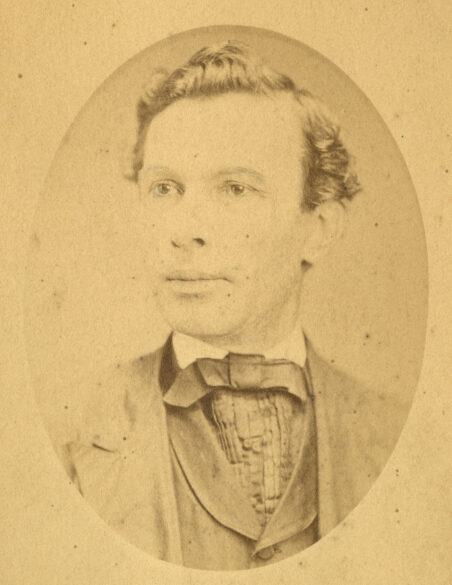
Archive photo of Father Jean Baptiste Mouton. Father Mouton died on Aug. 31, 1878 from Yellow Fever. (Photos from archives)
“Six of the sisters, all of them part of the original group at Holly Springs, died during September and October. Father Oberti died on Sept. 11. Over 300 of the townspeople perished, 30 of them Catholic.
“Dr. R.M. Swearingen, a volunteer from Austin, Texas, penciled a tribute to Sister Corinthia Mahoney on the plaster wall of a jury room.
“It remained there until 1925 when the courthouse was renovated.
“To save the tribute, R.A. McDermott had workmen remove that section of the wall. Then he took it to Nazareth, Ky., where it remained until 1971 when it was returned to Holly Springs to the Marshall County Historical Museum where it can be seen today.
Within this room, September 1878, Sister Corinthia sank into enteral sleep. Among the first to enter this realm of death, she was the last, save one, to leave. The writer of this humble notice saw her in health, gentle but strong, as she moved with noiseless step and serene smiles through the crowded wards. He saw her when the yellow plumed angel threw his golden shadows over the last sad scene, and eyes unused to weeping paid the tribute of tears to the brave and beautiful “Spirit of Mercy.” She needs no slab of Parisian marble With its white and ghastly head, To tell wanderers in the valley The virtues of the dead. Let the lily be her tombstone, And dewdrops pure and bright, The epitaphs the angels write In the stillness of the night. R.M. Swearingen, M.D. Austin, Texas Let no one deface.
“Father Oberti and the sisters were laid to rest in the local cemetery where a monument was erected by a grateful town. And Bethlehem Academy reopened its doors.”
Kudos to Shreveport for putting forward the five martyrs from their diocese. The clergy and sisters in our diocesan history may be called martyrs too.
(Mary Woodward is Chancellor and Archivist for the Diocese of Jackson.)
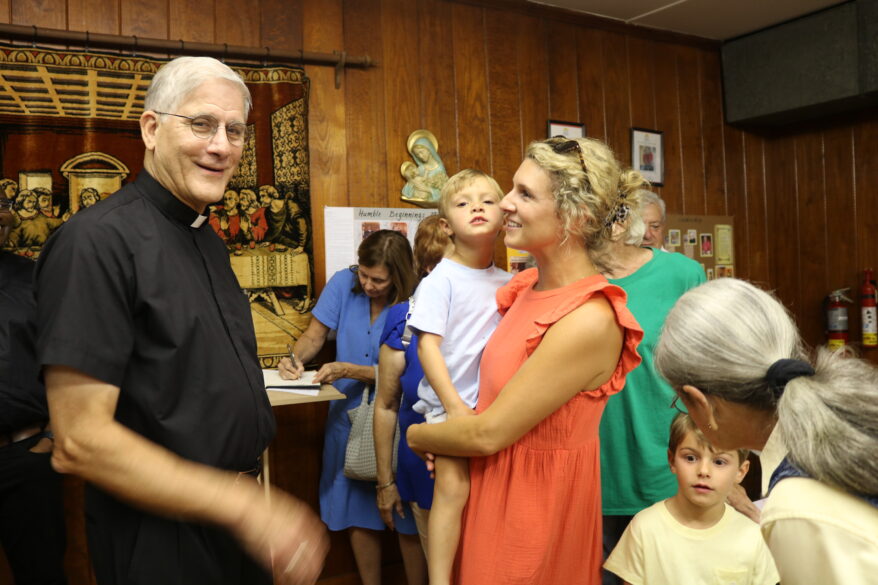
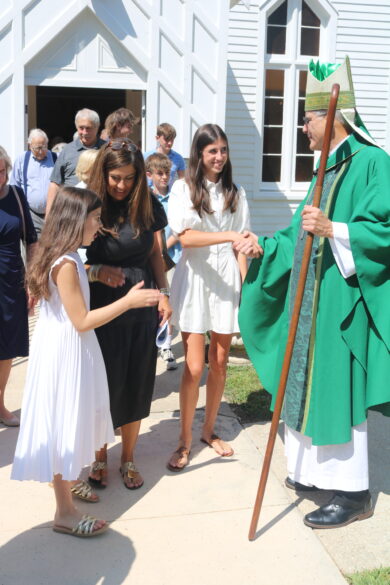
GLOSTER – Holy Family parish celebrated 40 years on Saturday, Sept. 9. Bishop Joseph Kopacz visits with Kayla Zumo with sons Charlie and Anthony, of Baton Rouge. (Photo by Tereza Ma)VICKSBURG – Chicka Chicka Boom Boom is a favorite of Vicksburg Catholic School Kindergartners! To really bring the story to life, each student made a snack that looked like a coconut tree. (Photo by Lindsey Bradley)MADISON – St. Joseph School celebrated Bruin teams with a special tailgate gathering on Wednesday, Aug. 23. Pictured are students and parents at attention during the National Anthem performed by the school band. (Photo by Tereza Ma)WOODVILLE – St. Joseph parish hosted their 150th anniversary on Sunday, Sept. 10. Bishop Kopacz shakes hands with Stella Ferguson, while Helen Claire Wesberny gets ready for her chance to greet her bishop. (Photo by Tereza Ma)
JACKSON – When Bishop Van de Velde arrived in Natchez on Dec. 18, 1853, he inherited a cathedral in debt and needing completion on top of repairs to what already was there.
In a letter to the Propagation of the Faith written on Jan. 2, 1854, Bishop Van de Velde describes the scene:
“When my venerable predecessor was nominated to the new Diocese of Natchez in 1841, he had not a Catholic church in this city. He had only one church and one priest in the whole extent of the diocese.
“The Catholics in general were poor and few in numbers, as they still are. He was forced to build a church here to serve as his Cathedral and he used all the money which he could obtain by gifts, subscriptions, contributions, collections, allotments, etc.
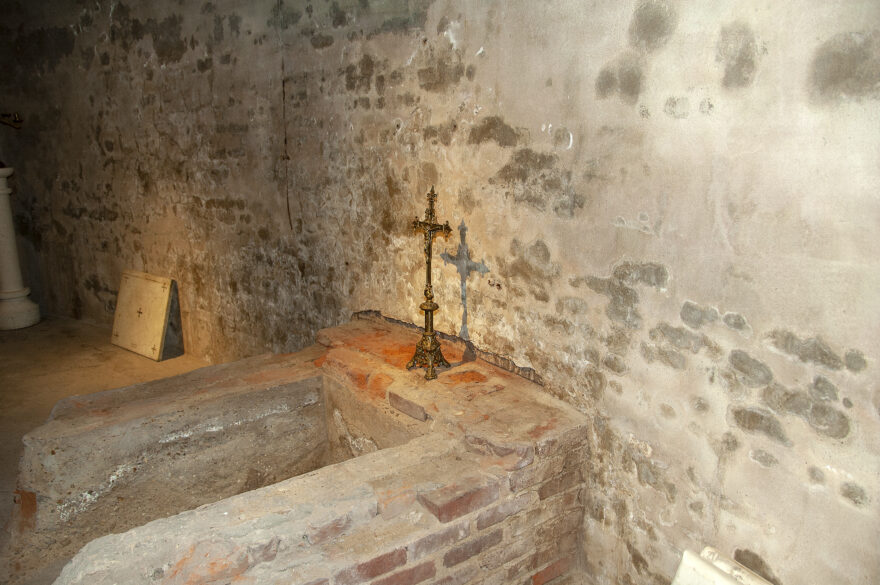
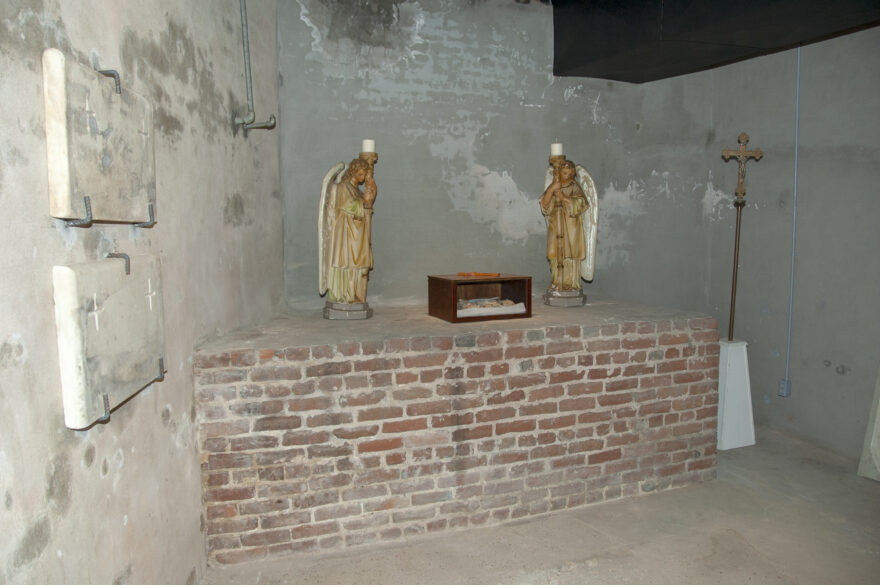
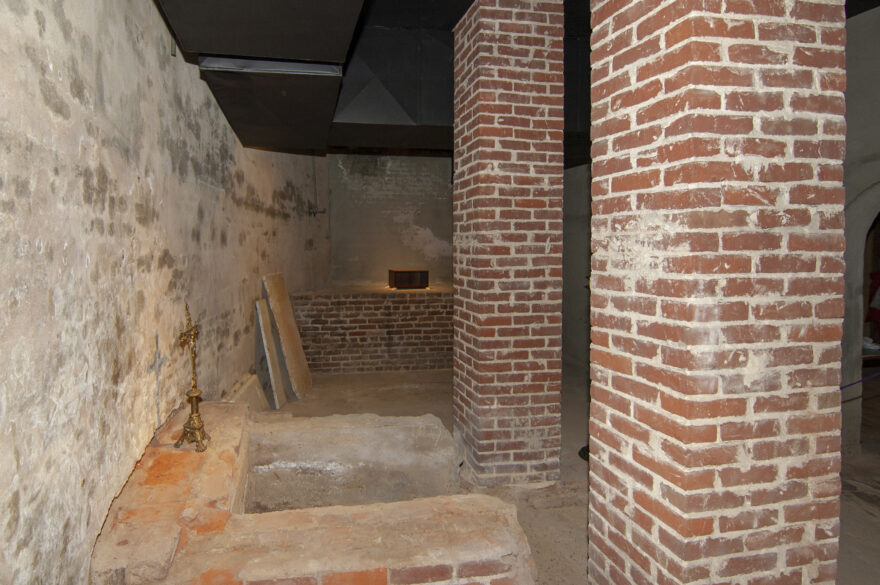
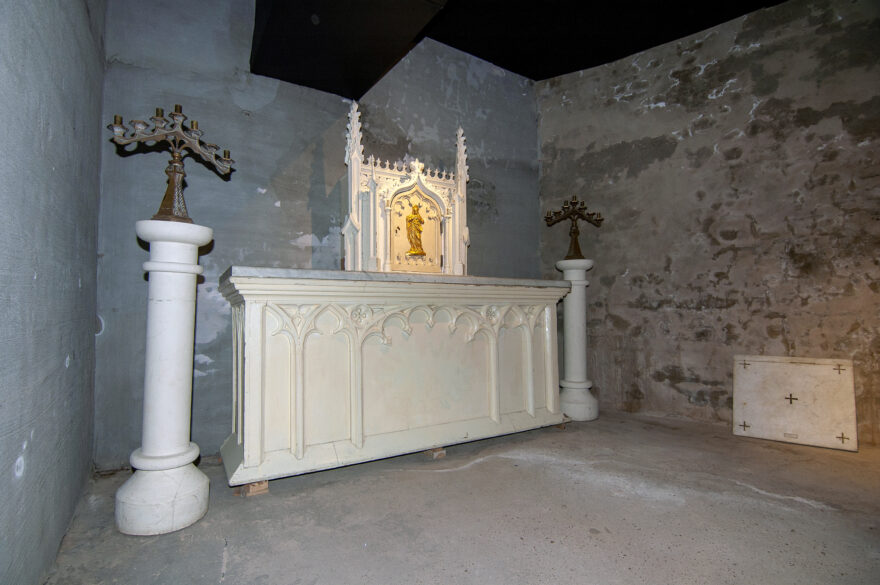
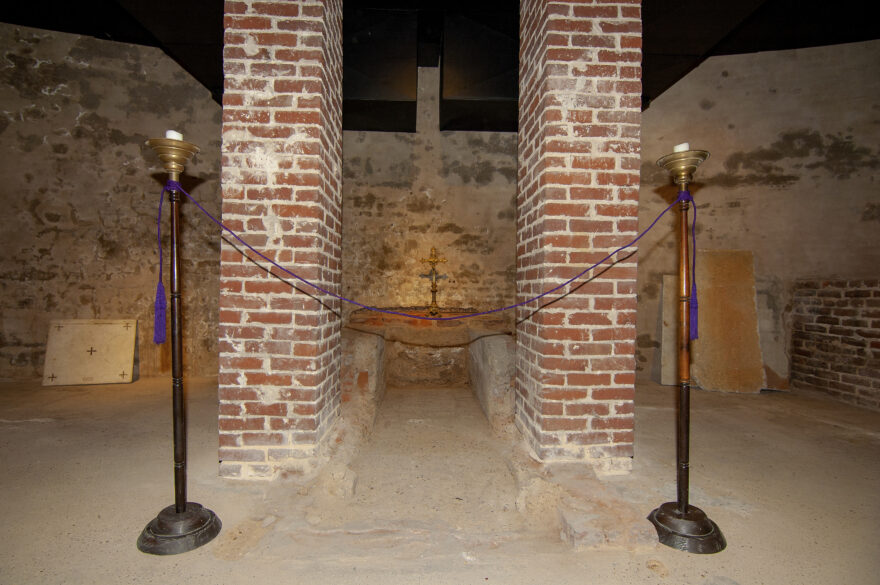
NATCHEZ – Bishop Van de Velde was buried in the crypt beneath the St. Mary Basilica sanctuary until 1874 when his remains were transferred by his Jesuit brothers to Florissant, Missouri. (Photos courtesy of St. Mary Basilica Archives/Mike Murphy)
“He contracted debts in building this church which he has left half-finished. There are walls, furniture and roof which already need to be renewed. The windows have been boarded up, leaving an opening in each one in which panes of glass have been placed.
“It is absolutely the appearance of a great barn, and it has been in this state since 1843.”
Archbishop Antoine Blanc of New Orleans gifted Bishop Van de Velde with around $2000. Adding that to a parish subscription, he was able to put a slate roof on the church and with some other funds collected locally and from the Propagation of the Faith was able to do some repairs.
As a diocese, Bishop Van de Velde maintained the 11 original parishes established by Bishop John Joseph Chanche at Natchez, Paulding, Biloxi, Jackson, Bay St. Louis, Pass Christian, Vicksburg, Sulphur Springs (Camden), Pearlington, Port Gibson and Yazoo City. There were also a few dozen mission stations being attended to monthly around these locations.
During his tenure, the Bishop tried to develop Catholic education in his diocese. He invited the Sisters of St. Joseph of Carondelet to staff a new mission and future school built at Sulphur Springs. Five Sisters journeyed down the Mississippi River to Vicksburg, where they were met by the Bishop. From there they travelled by stagecoach to Canton and on to Sulphur Springs.
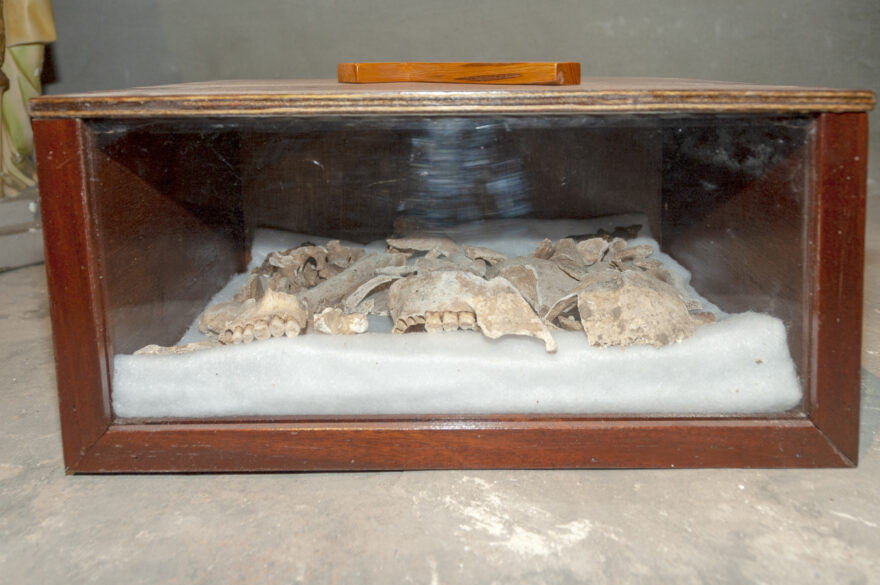
Bones from the old Spanish burial ground located behind St. Mary Basilica rest under the sanctuary of the church.
There is an interesting event that occurred along the journey which reflects an undercurrent of anti-Catholic sentiments in the State. The stagecoach owner apparently was one who expressed these sentiments as a member of the Know-Nothing movement. Simply put, the Know-Nothings believed Catholics were conspiring to subvert civil and religious liberties in the United States.
During the ride, the man, who also was intoxicated, accused our Bishop of being a priest and spat tobacco in his face several times in front of the five Sisters. Bishop Van de Velde maintained his composure and temper blocking the spew with his hat. Finally, when the stage stopped to change horses near Canton, Bishop Van de Velde threw the man out of the coach.
Another major education initiative of Bishop Van de Velde’s was to establish a Jesuit College at Rose Hill near Natchez. But this was not to be due to a lack of qualified clergy available for the endeavor and, the Jesuits were unable to accept the Bishop’s proposal.
Overall, Bishop Van de Velde was a much-loved bishop among the clergy and laity. His efforts to grow Catholic educational opportunities in his diocese show his commitment to further the faith in the State.
Back in the city of Natchez, the Bishop briefly obtained possession of the old Spanish burial ground located behind the church. The grounds had become a playground for children and dogs, with bones being unearthed and scattered. The city had even used some of the ground containing bones to level city streets. Bishop Van de Velde had all the bones gathered into two boxes and interred them in a crypt under the sanctuary in the church, then built a high wall around the rest of the area to protect the remaining graves.
In the fall of 1855, Natchez and Mississippi were under another siege of Yellow Fever. Several of the Cathedral staff were ill with the disease and suffering in the rectory next to the church. On Oct. 23, the Bishop fell on the steps of the rectory while going out in the evening to close the front gate. He fractured his leg in two places. Those inside suffering from fever were unaware of his predicament, and the poor Bishop had to lie there until morning when passersby heard his moans.
Soon the Bishop himself had contracted Yellow Fever and suffered for several days in agony. His beloved flock would pass by his room and receive a blessing from him while the fever raged. Then on Nov. 13 in the middle of blessing a parishioner, he succumbed to the illness.
After his funeral Mass, he was buried in the crypt beneath the sanctuary until 1874 when his Jesuit brothers took his remains to Florissant, Missouri. The Jesuit cemetery was relocated in Calvary Cemetery in St. Louis, Missouri, in 2006. Similar to his predecessor, he has been buried three times. Bless his heart. His prayerful desire to be a missionary priest led him along a circuitous path to frontier mission work. We are blessed by his short term here in our diocese.
A special thank you to the St. Mary Basilica Archives Committee, who provided photos for this article and facts from their web site: www.stmarybasilcaarchives.org.
(Mary Woodward is Chancellor and Archivist for the Diocese of Jackson.)
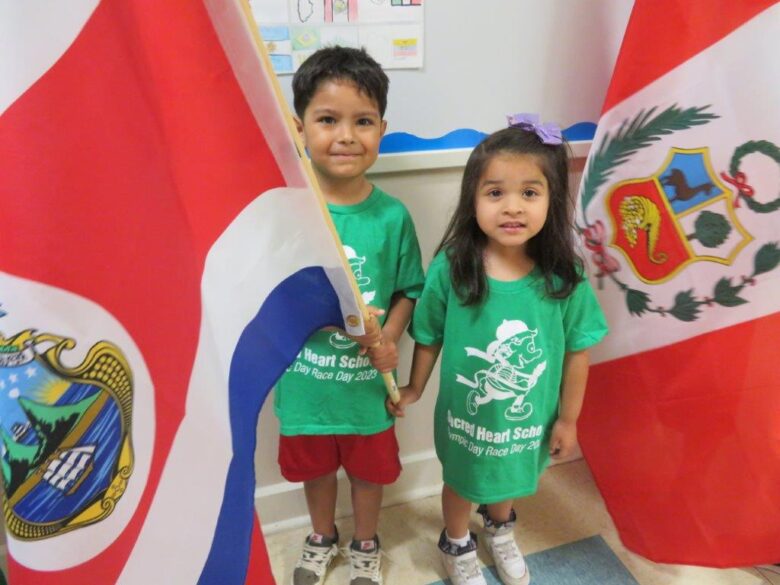
SOUTHAVEN – Lucas and Camilla line up for the “Parade of Nations” at the beginning of Olympic Day at Sacred Heart School on May 24. (Photo by Sister Margaret Sue Broker)JACKSON – St. Richard principal, Jennifer David, assists Penelope Starrett with some patriotic flair. (Photo by Chelsea Dillon)YAZOO CITY – St. Mary’s Church held Vacation Bible School from June 9-11, with the theme “Jesus is the Ticket.” (Photo by Babs McMaster)
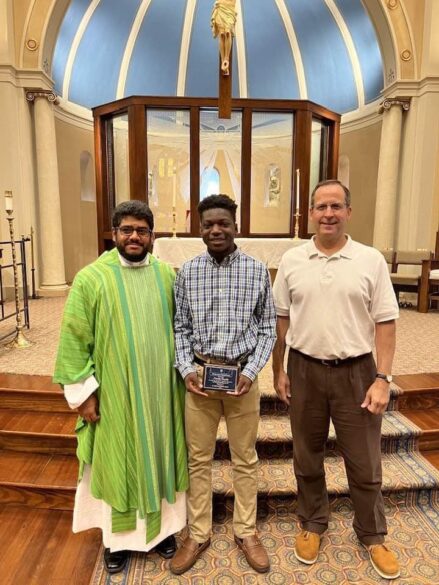
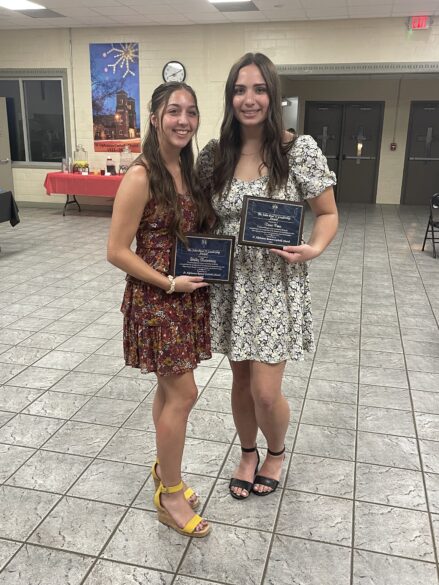
MCCOMB – (Above) Menelik Rozelle was awarded the Igor Santos Character Award and scholarship. The award was established by Dr. and Mrs. Michael Artigues in honor of a foreign exchange student that was tragically killed in an automobile accident. The award goes to a confirmation student that shows good character. Rozelle is pictured with Father Suresh and Dr. Artigues. (Right) Shelby and Dana Fortenberry were awarded the St. Pope John Paul II Leadership Award that goes to a senior in high school that helps lead their group in different ways. Both Shelby and Danana started the youth choir at St. Alphonsus and have been dedicated to make it succeed. (Photo by Mary L. Roberts)
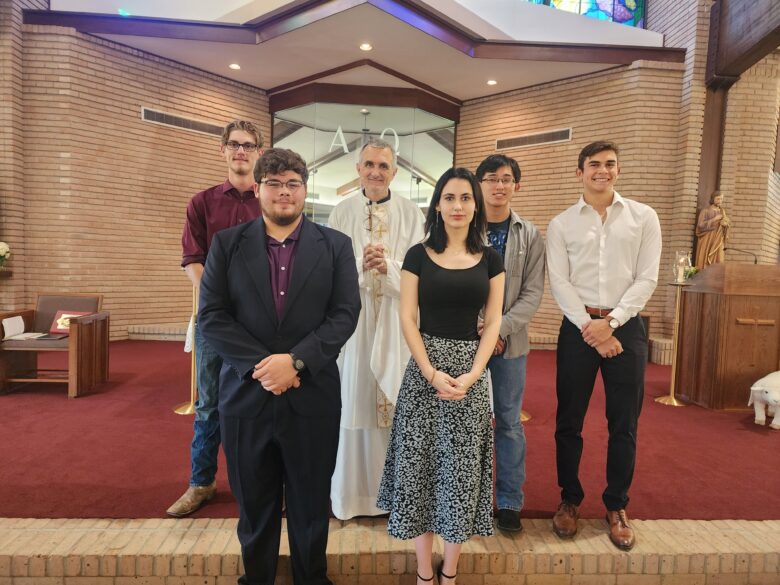
CLINTON – Class of 2023 seniors were recognized at Holy Savior on Saturday, May 6. Pictured (l-r): Ryan Callegan, Cade Tripp, Father Lincoln Dall, Emillie McCombs, Cole Hatch and Aidan Camillo. (Photo by Trish Ballard)
COLUMBUS – Annunciation student Gabriella Nguyen got ready for summer with some Field Day fun on Friday, May 12. (Photo by Logan Waggoner)
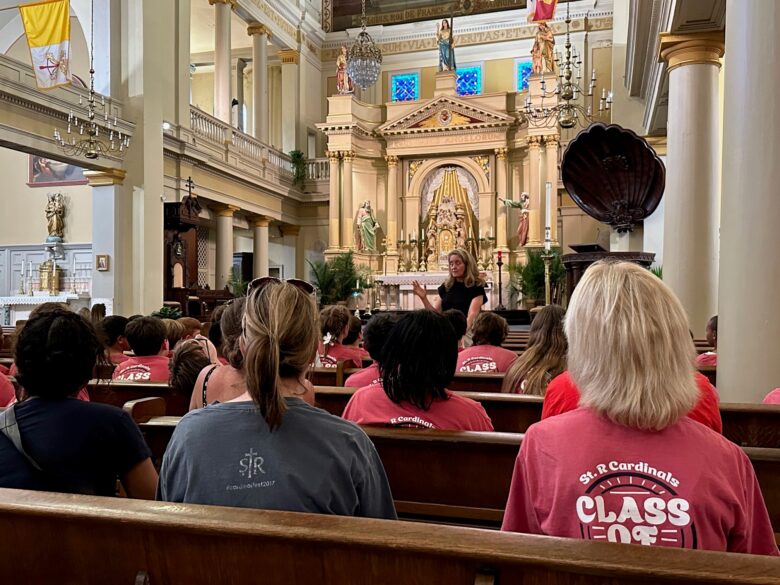
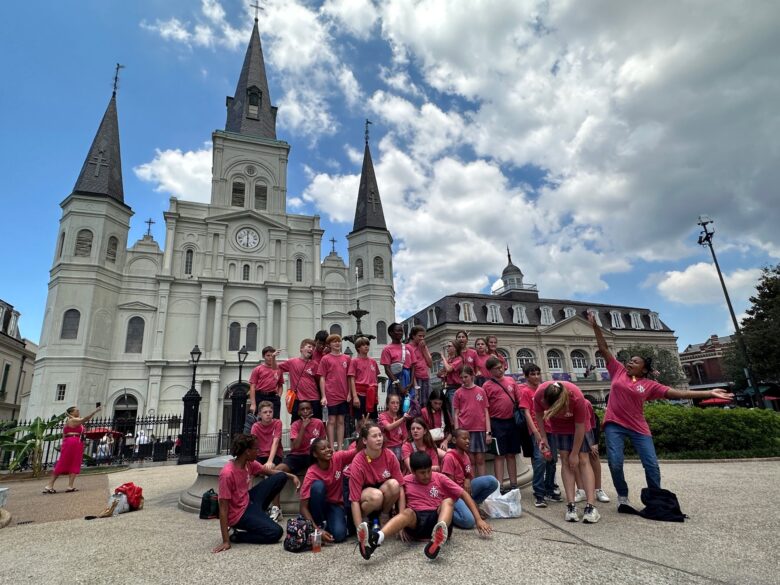
JACKSON – St. Richard sixth graders made a trip to New Orleans on Friday, May 19 where they visited the WWII museum and St. Louis Cathedral, where Jolie Sekinger gave them tour and brief history. (Photo by Tereza Ma)
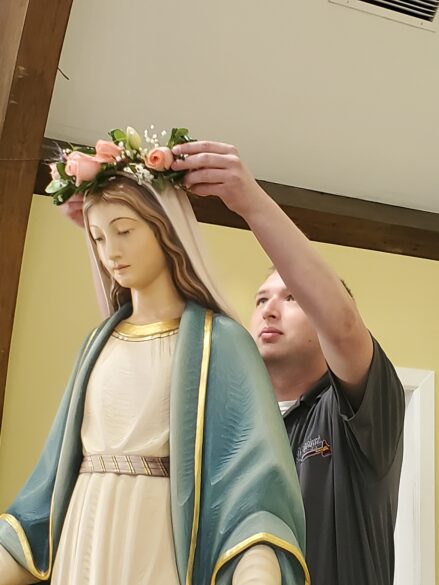
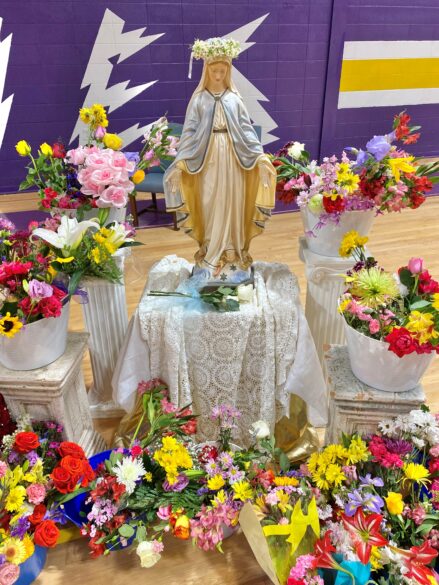
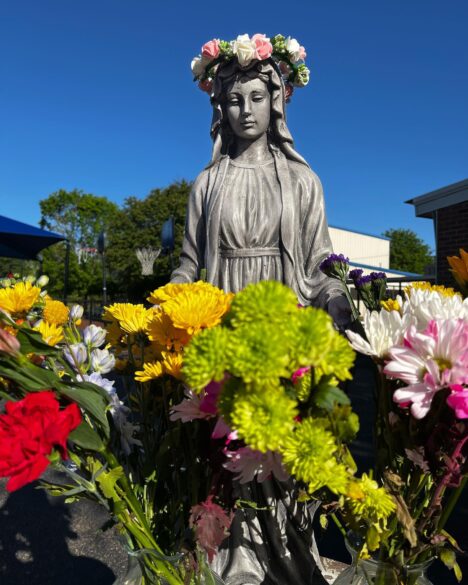
PEARL – Parishioners brought flowers to Mass in honor of the Blessed Virgin Mary on May 2 for May Crowning at St. Jude parish. Pictured is Josh Statham placing a crown of roses on the parishes statue of the Blessed Virgin Mary. (Photo by Rhonda Bowden)
First Communion Celebration
VICKSBURG – Several students recently celebrated their First Communion at Vicksburg Catholic School. Pictured are Collins Farmer, Amelia Guider, Benjamin Ponder, Mary Thompson Ratliff, Charlie Reeder, Joe Robert and Adeline Stewart. (Photo by Lindsey Bradley)
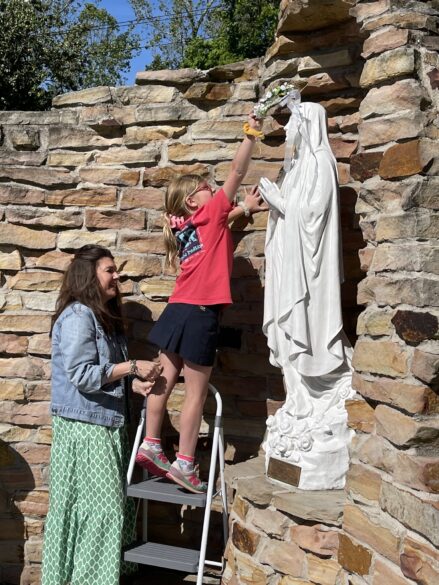
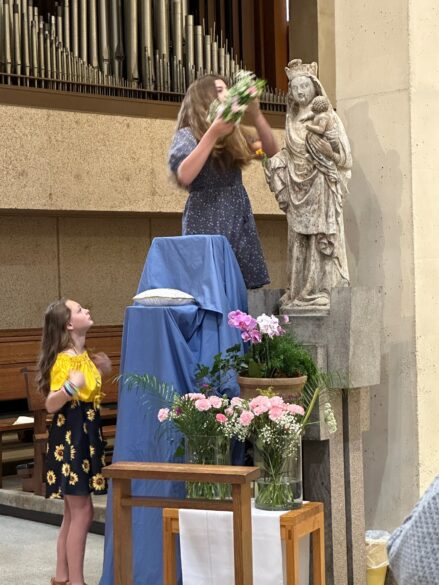
Sixth grade students led a May Crowning service at Vicksburg Catholic School on May 4. “O, Mary, we crown thee with blossoms today, Queen of the Angels, Queen of the May!” (Photos by Lindsey Bradley)
CLARKSDALE
Principal Sarah Cauthen and student Liza Stonestreet work together to crown Mother Mary. (Photo by Mary Evelyn Stonestreet)
JACKSON
St. Richard six graders, Hayden Couch and Maya work together to crown Mary at school Mass on Wednesday May 10. (Photo by Tereza Ma)
COLUMBUS
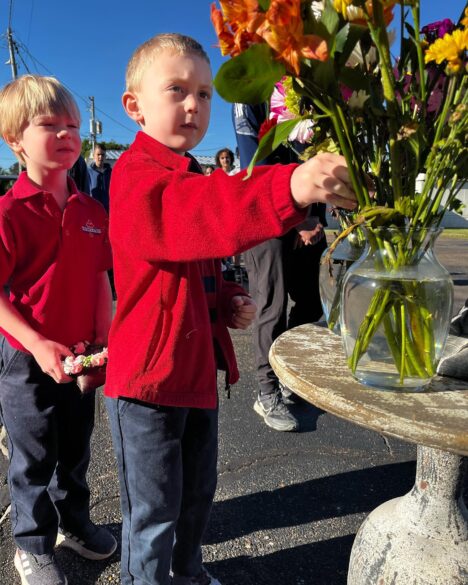
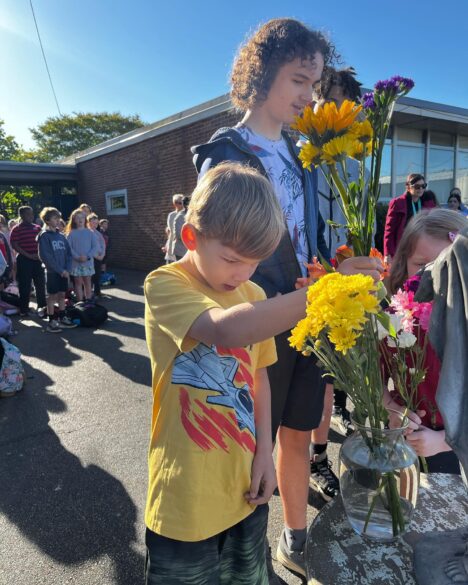
Logan Grant places a flower and Boone Morgan awaits his turn to honor Mary on Monday, May 1 at Annunciation School. (Photos by Logan Waggoner)
TUPELO
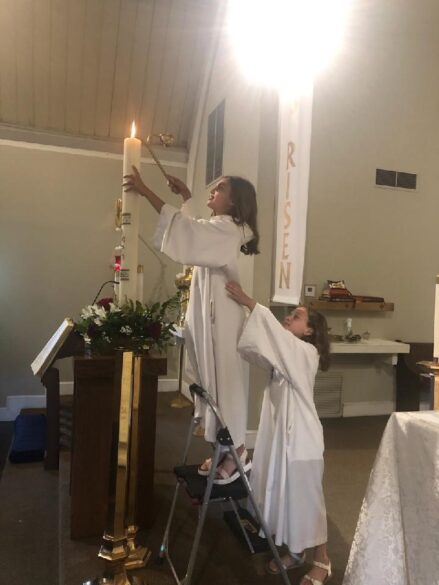
Light one candle! (Photo by Michelle Harkins)
CLARKSDALE
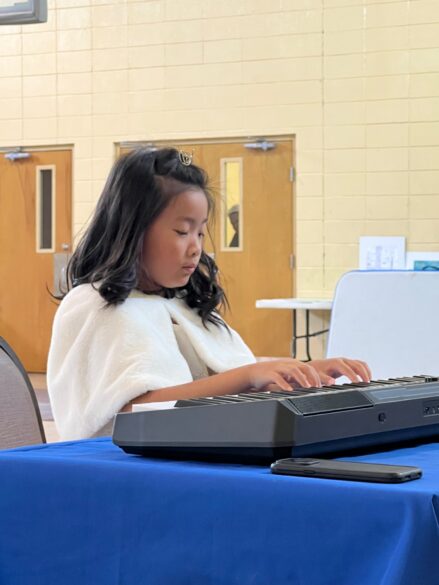
First grader, Olivia Lin displays her talent by playing the piano at St. Elizabeth School’s Got Talent: Talent Show. (Photos by Mary Evelyn Stonestreet)
MADISON
MADISON – St. Joseph Catholic School students celebrate their efforts that raised a record $19,665 at this year’s edition of BruinTHON – an annual student-driven fundraiser that benefits the Blair E. Batson Children’s Hospital in Jackson, part of the Children’s Miracle Network hospital. Their fundraising effort culminated the seven-hour, on-your-feet, marathon fundraiser BruinTHON on Friday, April 28, 2023, in the St. Joe gym. (Photo courtesy of school)
JACKSON
JACKSON – Recently, St. Richard fourth grade reading buddies visited their PreK-4 friends for some outdoor story time! (Photo by Tammy Conrad)
SOUTHAVEN
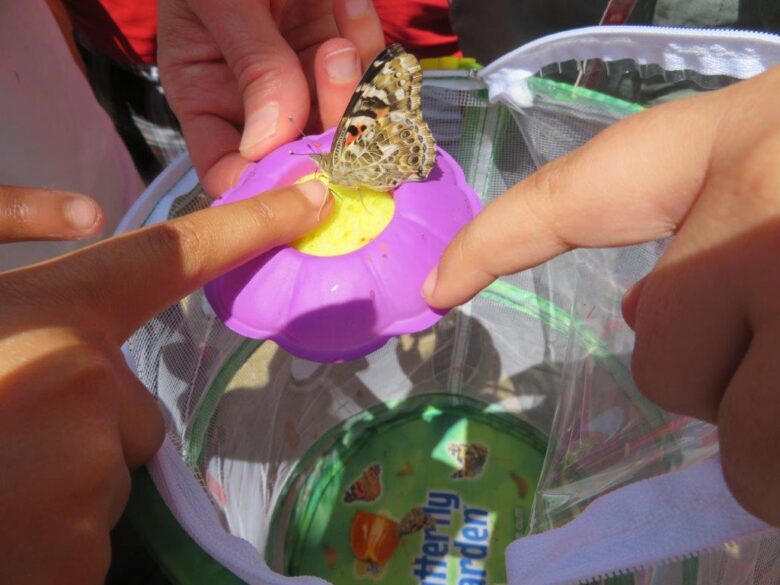
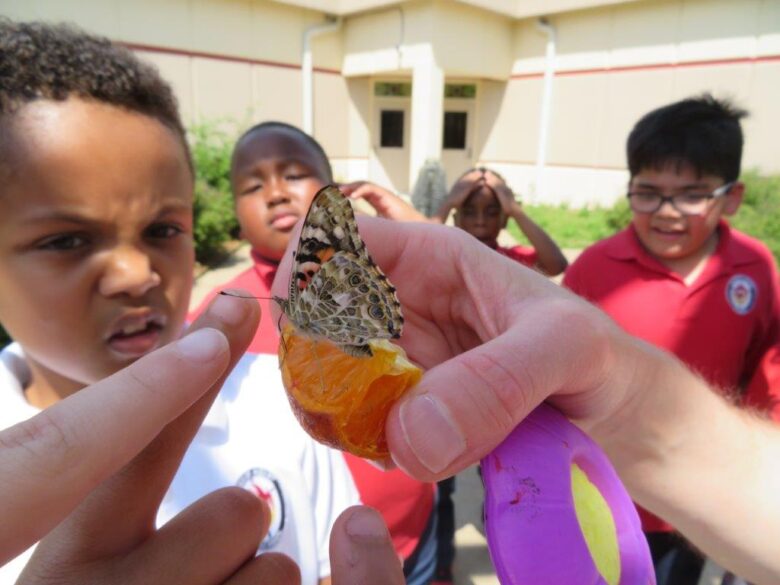
Mrs. Wade’s second grade class release butterflies they hatched. Pictured are Matthew and Aaric getting a very close look. (Photo by Sister Margaret Sue Broker)