By Kate Scanlon WASHINGTON (OSV News) – The Trump administration said Jan. 21 it would rescind a long-standing policy preventing Immigration and Customs Enforcement agents from making arrests at what are seen as sensitive locations, including houses of worship, schools and hospitals.
Prior to his second inauguration, Trump’s transition team indicated his administration would scrap the long-standing ICE policy – which prohibits immigration enforcement arrests at such locations, as well as other sensitive events like weddings and funerals without approval from supervisors. Catholic immigration advocates expressed alarm at the announcement.
Acting Department of Homeland Security Secretary Benjamine Huffman directed on Jan. 20 that those guidelines be rescinded, as well as issuing another directive restricting parameters for humanitarian parole, a DHS spokesperson said.
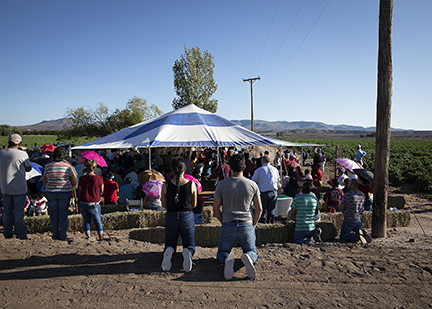
Migrant farmworkers attend an outdoor Mass Sept. 26, 2019, in Hatch, N.M. The Trump administration said Jan. 21, 2025, that it would rescind a long-standing policy preventing Immigration and Customs Enforcement agents from making arrests at what are seen as sensitive locations, including houses of worship, schools and hospitals. (OSV News photo/Tyler Orsburn)
“This action empowers the brave men and women in CBP and ICE to enforce our immigration laws and catch criminal aliens – including murders and rapists – who have illegally come into our country,” a DHS spokesperson said. “Criminals will no longer be able to hide in America’s schools and churches to avoid arrest. The Trump Administration will not tie the hands of our brave law enforcement, and instead trusts them to use common sense.”
Bishop Mark J. Seitz of El Paso, Texas, said in a Jan. 21 statement the policy change is one of “many drastic actions from the federal government related to immigration that deeply affect our local community and raise urgent moral and human concerns.”
“The end of the Department of Homeland Security’s sensitive locations policy strikes fear into the heart of our community, cynically layering a blanket of anxiety on families when they are worshiping God, seeking healthcare and dropping off and picking up children at school,” Bishop Seitz said. “We have also seen the rapid and indiscriminate closure of the border to asylum seekers and the return of the ill-conceived Remain in Mexico policy, violating due process and restricting the few legal options available to the most vulnerable who knock on our door seeking compassion and aid.”
Bishop Seitz added that he wanted to assure El Paso’s immigrant community that “whatever your faith and wherever you come from, we make your anxieties and fears at this moment our own.”
“We stand with you in this moment of family and personal crisis and pledge to you our solidarity, trusting that the Lord, Jesus Christ, will bring about good even from this moment of pain, and that this time of trial will be just a prelude to real reform, a reconciled society and justice for all those who are forced to migrate,” he said.
The Diocese of El Paso, Bishop Seitz added, “will continue to educate our faithful on their rights, provide legal services and work with our community leaders to mitigate the damage of indiscriminate immigration enforcement. Through our Border Refugee Assistance Fund, in partnership with the Hope Border Institute, we are preparing to channel additional humanitarian aid to migrants stranded in our sister city of Ciudad Juarez.”
Dylan Corbett, executive director of Hope Border Institute, told OSV News, “The reversal of the sensitive locations policy is gravely troubling and will have an immediate impact on families in our parishes as well as on our Catholic educational institutions and service organizations.”
“It is an attack on members of our community at pivotal moments in their life – dropping off and picking up children, seeking out health care and worshipping God,” he said. “There are serious religious liberty implications and it strikes at the core of the trust that is indispensable to a safe community. It is also a sad and troubling step in the direction of indiscriminate deportations.”
South Dakota Gov. Kristi Noem, who has also taken hardline immigration positions, is Trump’s nominee to lead the Department of Homeland Security, but she has not yet been confirmed by the Senate.
(Kate Scanlon is a national reporter for OSV News covering Washington. Follow her on X @kgscanlon.)
By Kate Scanlon WASHINGTON (OSV News) – Executive orders signed by President Donald Trump on issues including migration, the environment and the death penalty are “deeply troubling,” Archbishop Timothy P. Broglio, president of the U.S. Conference of Catholic Bishops, said in a Jan. 22 statement, while praising another on gender policy.
Among the first acts of his second term beginning Jan. 20, Trump signed a slew of executive orders. Some implement his hardline policies on immigration, including seeking to change the interpretation of birthright citizenship under the 14th Amendment, an order that prompted a legal challenge. Others include withdrawing from the 2015 Paris Agreement on climate and another sought to expand the use of the federal death penalty. Trump also signed an order directing the U.S. government to only recognize two sexes, male and female.
Archbishop Broglio, who heads the U.S. Archdiocese for the Military Services, said many of the topics that the first batch of executive orders concern “are matters on which the Church has much to offer.”
“Some provisions contained in the Executive Orders, such as those focused on the treatment of immigrants and refugees, foreign aid, expansion of the death penalty, and the environment, are deeply troubling and will have negative consequences, many of which will harm the most vulnerable among us,” he said. “Other provisions in the Executive Orders can be seen in a more positive light, such as recognizing the truth about each human person as male or female.”
Archbishop Broglio stressed that neither the Catholic Church nor the USCCB is “aligned with any political party.”
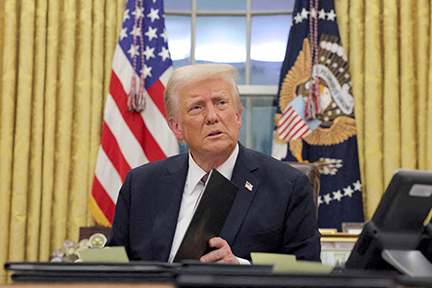
U.S. President Donald Trump signs documents in the Oval Office at the White House on Inauguration Day in Washington Jan. 20, 2025. He signed a series of executive orders including on immigration, birthright citizenship and climate. Trump also signed an order directing the U.S. government to only recognize two sexes, male and female. (OSV News photo/Carlos Barria, Reuters)
“No matter who occupies the White House or holds the majority on Capitol Hill, the Church’s teachings remain unchanged,” he said. “It is our hope that the leadership of our Country will reconsider those actions which disregard not only the human dignity of a few, but of us all.” Executive orders are legally binding directives from the president and are published in the Federal Register. At the same time, the term “executive actions” is broader and may include informal proposals for policy the president would like to see enacted. While it is typical for new presidents to issue some executive orders on their first day in office to signal certain priorities, Trump signed a larger number of orders than usual.
Citing the current Jubilee Year of Hope declared by Pope Francis, Archbishop Broglio said, “As Christians, our hope is always in Jesus Christ, who guides us through storm and calm weather.
“He is the source of all truth,” Archbishop Broglio said. “Our prayer is one of hope that, as a Nation blessed with many gifts, our actions demonstrate a genuine care for our most vulnerable sisters and brothers, including the unborn, the poor, the elderly and infirm, and migrants and refugees. The just Judge expects nothing less.”
Also among its first actions, the Trump administration said Jan. 21 it would rescind a long-standing policy preventing Immigration and Customs Enforcement agents from making arrests at what are seen as sensitive locations, including houses of worship, schools and hospitals.
Bishop Mark J. Seitz of El Paso, Texas, said in a Jan. 21 statement the policy change is one of “many drastic actions from the federal government related to immigration that deeply affect our local community and raise urgent moral and human concerns.”
Bishop Seitz, who heads the USCCB’s migration committee, told reporters at the bishops’ general assembly in November that the bishops would watch how Trump’s migration policy actually unfolds and “raise our voice loudly” if those policies violate basic human rights protections.
(Kate Scanlon is a national reporter for OSV News covering Washington. Follow her on X @kgscanlon.)
By Gina Christian and Kate Scanlon WASHINGTON (OSV News) – Catholic bishops and immigration advocates are expressing numerous concerns over a flurry of executive orders issued by newly inaugurated President Donald Trump – including one that ordered the State Department’s cancellation of all refugee travel to the U.S. by Jan. 27.
Bishop Mark J. Seitz of El Paso, Texas, chair of the U.S. Catholic bishops’ migration committee, said in a Jan. 22 statement Trump’s order was “unmerited” saying refugee resettlement is “one of the most secure legal pathways to the United States.”
He said that “national self-interest does not justify policies with consequences that are contrary to the moral law.”
Archbishop Timothy P. Broglio of the U.S. Archdiocese for the Military Services, president of the U.S. bishops’ conference, said in a statement that Trump’s executive orders on the migrants and refugees were among those the bishops found “deeply troubling.”
Kevin Appleby, senior fellow for policy and communications at the Center for Migration Studies of New York, said the U.S. “has successfully resettled refugees in the U.S. over the decades without a security breach.”
Appleby said that “to shut the door on refugee families who have already been processed, vetted, and prepared to travel is the height of cruelty.”
“The program has successfully resettled refugees in the U.S. over the decades without a security breach,” said Appleby. “There is no justified reason to halt it, other than to serve an anti-immigrant agenda.”
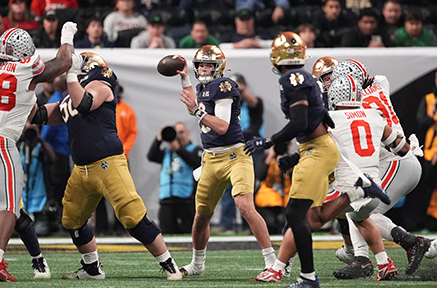
Notre Dame Fighting Irish quarterback Riley Leonard (13) throws a pass against the Ohio State Buckeyes in the first half in the CFP National Championship college football game at Mercedes-Benz Stadium in Atlanta Jan. 20, 2025. Ohio State defeated seventh-seeded Notre Dame 34-23. (OSV News photo/Dale Zanine-Imagn Images via Reuters) Editors: Mandatory Credit.
NATION ATLANTA (OSV News) – Notre Dame’s quest for a 12th national title ended in heartbreak with a 34-23 loss to Ohio State in the College Football Playoff national championship Jan. 20 at Mercedes-Benz Stadium in Atlanta. Head coach Marcus Freeman and captains Riley Leonard and Jack Kiser faced the media with heavy hearts but praised their team’s perseverance and faith. “It’s a tough moment,” Freeman said. But of the team he said, “I’m just proud of them and proud of what they’ve done.” Leonard, who transferred from Duke for his senior year, thanked Jesus Christ and highlighted Scripture that inspired him, including Matthew 23:12 and Proverbs 27:17. He acknowledged his disappointment but credited Notre Dame’s coaches and players for shaping his journey. Kiser, reflecting on six seasons with the Irish, emphasized the program’s culture. “It’s the people that make this place different,” he said.
KEY WEST, Fla. (OSV News) – A lot has changed in the lower Florida Keys since the 1980s, when declining enrollment led to the closure of the Catholic high school in the oldest and southernmost parish of the Archdiocese of Miami. But a surge in local economic development, tourism jobs and a renewed demand for private and Catholic education in Monroe County culminated Dec. 13 in the dedication Mass and grand opening of a refurbished Basilica High School building and facility at the Basilica of St. Mary Star of the Sea Parish and School in Key West. Miami Archbishop Thomas G. Wenski presided at the dedication Mass and grand opening. The new facility will allow for full enrollment in 2025 of all four grades under the leadership of principal and president Robert Wright and will serve as an answered prayer for local parents who had few options for private education in Monroe County. The nearest Catholic high school was located in Miami-Dade County, meaning some families left the Key West area in search of a Catholic education for their children, while others settled for public education.
VATICAN ROME (CNS) – Before the millions of pilgrims expected to come to Rome during the Holy Year 2025 cross through the Holy Door of St. Peter’s Basilica, they will be met by smiling faces and lime green jackets. Jubilee volunteers of all ages and nationalities have become a mainstay along the boulevard leading up to St. Peter’s Square since the start of the Holy Year. Wearing uniforms emblazoned with “volontario” across their backs and the Jubilee and Vatican logos on their chests, the volunteers line the pilgrims’ path, offering guidance and companionship on their spiritual journey. They escort pilgrims along the final leg of their pilgrimage to the Holy Door, checking passes, providing directions and accompanying groups in prayer. For Craig and Laura Shlattmann – a married couple of Jubilee volunteers from Tacoma, Washington – participating in the current Holy Year has been 25 years in the making. Craig was stationed in Italy for military service, and the couple lived in Rome during the Holy Year 2000. Back then they “vowed, God willing, to come back for the next ordinary Jubilee year in 2025,” Laura told Catholic News Service. After Craig’s recent retirement, the couple decided to fulfill that promise. “We returned not just for ourselves … but also to help our family, friends and everyone who comes to Rome,” Craig said Jan. 23. “It’s been a real blessing.”
VATICAN CITY (CNS) – Taking up the spirit of the recently inaugurated Holy Year 2025, the Cuban government has announced the release of 553 people currently serving prison sentences. Cuba said it would gradually release the prisoners “in the spirit of the Ordinary Jubilee of the year 2025 declared by His Holiness” following a “thorough analysis” of the legal and humanitarian avenues to enact their release, Cuba’s Ministry of Foreign Affairs announced in a statement Jan. 14. The statement did not specify who would be among the 553 prisoners designated to be released. That same day, the White House announced that it will no longer designate Cuba as a state sponsor of terrorism and that it would eliminate some restrictions on Cuba. The White House said the actions were steps “to support the Cuban people as part of an understanding with the Catholic Church under the leadership of Pope Francis and improve the livelihoods of Cubans.” Following the announcement, Cardinal Seán P. O’Malley, retired archbishop of Boston, said that for the last several years he had carried messages from Pope Francis to the presidents of the United States and Cuba “seeking the release of prisoners in Cuba and improved relationships between the two countries for the good of the Cuban people.”
WORLD JERUSALEM (OSV News) – Catholic leaders in the Holy Land are urging Christians to return on pilgrimage to the region now that a ceasefire has been established between Israel and Hamas. In a video, the Latin patriarch, Cardinal Pierbattista Pizzaballa, and the custos of the Holy Land, Franciscan Father Francesco Patton, walk through Jerusalem, talking to pilgrims and shopkeepers who have endured streets emptied of tourists since the Oct. 7, 2023, Hamas attack on Israel and the subsequent 15-month war. The area is safe, the Holy Land church leaders stressed. Father Patton emphasized the spiritual importance of visiting holy sites. Cardinal Pizzaballa called the ceasefire a “turning point” for the Holy Land, thanking churches worldwide for their support during the challenging year. Father Gabriel Romanelli from Gaza City’s Holy Family Parish expressed hope for lasting peace, despite the ongoing challenges.
PARIS (OSV News) – After Notre Dame Cathedral’s splendid reopening, the attention of Paris Catholics turned to the nearby Church of Notre Dame de Boulogne Jan. 12 as it was solemnly elevated to the rank of minor basilica, following a decree from Pope Francis, signed June 29. The Jan. 12 elevation ceremony was presided over by Bishop Matthieu Rougé of Nanterre, along with the apostolic nuncio to France, Archbishop Celestino Migliore. Located in the town of Boulogne-Billancourt, Notre Dame de Boulogne has deep historical roots, dating back to 1319 when French King Philip IV founded it to replicate a pilgrimage site in northern France. Over 700 years later, the church is still a center of faith in the region. Bishop Rougé said reviving its spiritual mission is important, especially because it is located in a major economic hub of the Paris metro area. The church’s rich architecture blends Gothic and 19th-century styles, and the church itself is a popular place of devotion for locals and visitors alike. Bishop Rougé hopes its new basilica title will invigorate evangelization efforts and provide spiritual hope in an increasingly secular society. Notre Dame de Boulogne is now the 176th basilica in France.
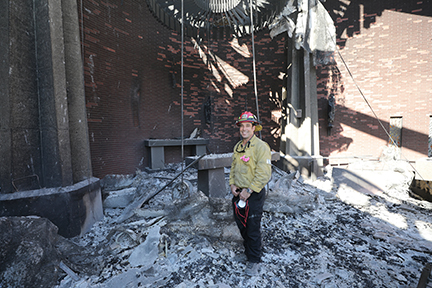
By Maria Wiering LOS ANGELES (OSV News) – Four days after Corpus Christi Church was incinerated in the Palisades Fire, Capt. Bryan Nassour of the Los Angeles Fire Department picked his way over a 6-foot layer of rubble in the ashen bones of the sanctuary and recovered the tabernacle Jan. 11. “I did it because the whole community has been decimated – it looks like a nuclear bomb has gone off and nothing is standing,” Nassour told Angelus, the news outlet of the Los Angeles Archdiocese. Nassour’s family belongs to St. Francis de Sales Church in Sherman Oaks, and his brother belongs to Corpus Christi.
Capt. Bryan Nassour of the Los Angeles Fire Department poses inside the destroyed Corpus Christi Church in Pacific Palisades on the west side of Los Angeles Jan. 15, 2025, in the aftermath of the wildfires. Nassour and other first responders help to recover items out of the church during the fire. (OSV News photo/Bob Roller)
“My brother lost his home. I have close friends who lost everything but the shirts on their backs, and they belong to that church too. So, if I could save just one thing, let it be this, so they have something to believe in,” he said.
That Saturday morning Nassour, whose station in Pacific Palisades is across the street from Corpus Christi, had been up all night battling other fires. As he sipped coffee at his desk and gazed at the ruined church, he decided to check for valuables. He wanted to protect them from looters and perhaps return something meaningful to the parish.
Scorched bricks, tiles and hunks of debris filled the nave so high that he had to crawl under the top of door frames that no longer had doors. The roof had collapsed, a burned steel frame teetered above the twisted remains of a chandelier. The pews had been consumed. Only the granite altar remained, with the solid brass tabernacle atop it and a cross above. The Blessed Sacrament was intact.
Nassour was astounded to find that the tabernacle weighed more than 300 lbs. His crew helped him get it into the station house.
“It was one of the most uplifting things,” he said. “Not everyone is religious, but they saw that and they’re like, ‘This is awesome.’ We’re doing something – at least one thing – that we can salvage for the community.”
He made many calls before he was able to reach Msgr. Liam Kidney of Corpus Christi to tell him that the tabernacle was safe and undamaged.
“He was in utter disbelief,” Nassour said.
Nassour offered to search for other sacred objects and the priest told him where to find the chalices and patens. Firefighters from Station 69 helped dig for the crushed cabinet. The chalices and patens had been severely damaged. But the firefighters recovered other sacred objects, including three unbroken containers of holy oil.
Brass withstands high heat, but Nassour suspects more was involved in the tabernacle’s survival. “Talk to any firefighter. In any religious building what usually survives is the cross and certain specific items that are highly religious, unless they’ve been specifically set on fire,” he said.
Gabe Sanchez, a retired FBI special agent who does contract investigations for the Los Angeles Archdiocese, was sent to retrieve the tabernacle. Firefighters helped him wrestle it into his car. He drove it to St. Monica Church, where Msgr. Kidney celebrated Mass for survivors the next day.
At that Mass, the tabernacle stood on a table by the altar. Msgr. Kidney recounted Nassour calling him to ask, “I have found this big gold box. What would you like me to do with it?”
The Corpus Christi parishioners burst into applause.
Nassour was unable to attend because he was fighting fires.
(Ann Rodgers writes for Angelus, the news outlet of the Archdiocese of Los Angeles.)
(OSV News) – A new report confirms OSV News’ previous finding that U.S. Catholic dioceses and eparchies have paid more than $5 billion to settle abuse claims filed over the past two decades — but credible allegations have declined significantly over the same period, with the majority of cases preceding a landmark set of anti-abuse protocols established by the U.S. bishops in 2002.
Catholic dioceses, eparchies and parishes in the U.S. have “changed how they do things” in terms of addressing and preventing abuse, said Jonathan L. Wiggins, sociologist and director of parish surveys at the Center for Applied Research in the Apostolate at Georgetown University.
On Jan. 15, CARA – which conducts social scientific studies on the Catholic Church — released a 20-year summary of annual data for the U.S. Conference of Catholic Bishops’ yearly report on the implementation of the “Charter for the Protection of Children and Young People.”
The document – adopted by the USCCB in 2002, and commonly called the Dallas Charter — lays out a comprehensive set of procedures for addressing allegations of sexual abuse of minors by Catholic clergy. The charter also includes guidelines for reconciliation, healing, accountability and prevention of abuse.
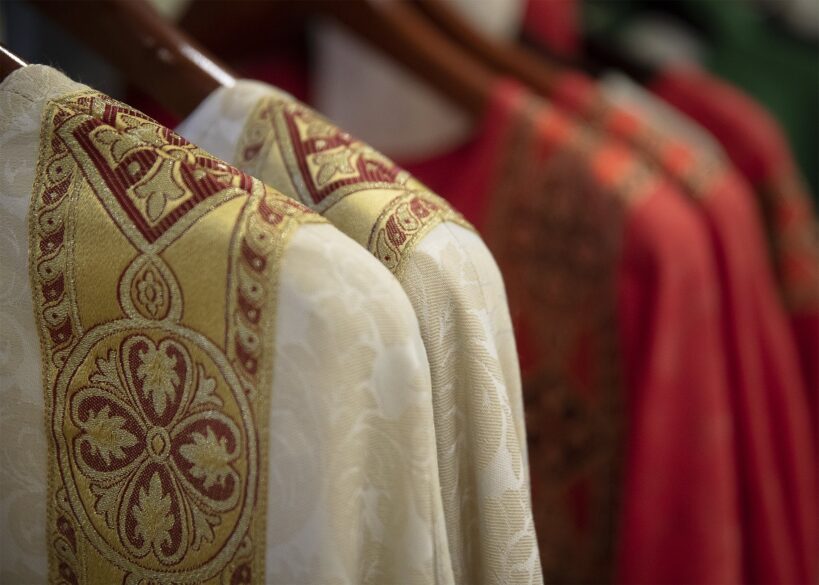
Vestments are seen in this undated photo. The Center for Applied Research in the Apostolate in Washington on Jan. 15, 2025, issued a new comprehensive report on the U.S. Catholic Church’s response to the sexual abuse of minors, compiling 20 years of data from dioceses, eparchies and religious communities of men detailing abuse allegations as well as the costs of addressing allegations and safeguarding youth. (OSV News photo/Tyler Orsburn, CNS archive)
CARA’s two-decade review of the numbers indicates that the charter is working, and that the Catholic Church in the U.S. is making real progress in eradicating the scourge of clerical abuse, said Wiggins.
Since 2004, CARA has collected and prepared data for the USCCB on the charter’s implementation, using both web-based and mail-in surveys.
The CARA surveys complement the annual audit of dioceses and eparchies conducted by a USCCB-commissioned third-party firm, which since 2011 has been StoneBridge Business Partners, a Rochester, New York-based consulting firm that provides forensic and compliance services to a range of organizations. (Religious communities of men do not participate in the Dallas Charter audit process, but many instead seek separate accreditation for commonly accepted abuse prevention and protocols.)
Response rates for CARA’s voluntary annual surveys have averaged 99% for dioceses and eparchies and 72% for religious communities of men, according to the CARA summary report. Wiggins noted to OSV News that the Conference of Major Superiors of Men has “worked very hard to encourage their members to participate” in the annual CARA surveys, but stressed that the conference was a “voluntary collective” that could not compel such participation.
Catholic dioceses and parishes in the U.S. have “completely reformed how they recruit people, how they report,” Wiggins said. “They’ve made a public invitation to bring allegations (forward). They do background checks on everyone, not just at the diocesan level but in parishes. They train people about sex abuse.”
According to the report, dioceses, eparchies and religious communities spent a total of almost $728 million over the past 20 years in safe environment salaries, training programs and background checks. Those costs increased 80% over the span of the report period.
Wiggins described the shift in approach as “quite amazing” – and a “story that doesn’t get out” unless the data is viewed longitudinally, and in a national context, rather than simply through media coverage of a given diocesan abuse settlement.
“Sometimes the headlines make it sound like everyone’s having a whole lot of allegations all the time,” he said.
For the period 2004-2023, a total of 16,276 allegations of minors by priests, deacons and religious were deemed credible by dioceses, eparchies and religious communities in the U.S. — 82% by dioceses and eparchies, and 18% by religious orders.
An allegation, defined as “one victim alleging an act or acts of abuse by one alleged perpetrator,” can represent “a single assault or for a series of assaults on a single victim over many years,” the report said.
But, CARA stressed, “to be clear, these credible allegations of abusive behaviors did not occur over the 20 years of the survey, but rather over the more than 80 years asked about on the annual surveys.”
During the 20-year survey period, said the report, “a majority of dioceses, eparchies, and religious communities of men did not have a credible allegation, with an average of three in five (60%) having no allegations in a particular survey year.”
The summary report said that “more than nine in ten of all credible allegations occurred or began in 1989 or earlier (92%), 5% occurred or began in the 1990s, and 3% occurred or began since the year 2000.”
Most of the alleged perpetrators – 86% – “were identified as ‘deceased, already removed from ministry, already laicized, or missing,'” said the report.
That figure is “not surprising,” said CARA in its Jan. 15 media release, “as about seven-tenths (72%) of the alleged abuses occurred in 1979 or earlier, 20 to 50 years before the first CARA survey was conducted in 2004.”
The other 14% were “permanently removed from ministry or retired from ministry during the year” of that particular survey, said the report.
The report also found that 95% of the alleged abusers were priests, with 80% diocesan and 15% religious, while 4% were religious brothers and 1% were diocesan or religious deacons.
The majority of abuse victims (80%) were male, and over half (56%) were ages 10-14 at the start of the abuse, with 24% ages 15-17 and 20% age 9 or less.
The report did not speculate on possible factors behind the demographics of alleged abusers and their victims, and Wiggins told OSV News such considerations were beyond the scope of study.
However, according to research cited by RAINN (Rape, Abuse and Incest National Network), which operates the National Sexual Assault Hotline (800-656-HOPE), a majority of child abuse perpetrators (88%) are male.
Wiggins also highlighted the methodological adaptations he and his fellow researchers have had to make over the years as the clerical abuse scandals have unfolded.
One such adaptation was the 2016 addition of a new survey classification for claims: “unable to be proven.”
While “credible” and “unsubstantiated” allegations are deemed as such based on evidence gathered through an investigation, CARA began listing the “unable to be proven” category to capture those claims for which “limited information was known and a thorough preliminary investigation was unable to occur.” The reasons for the lack of information include: deceased parties in a given allegation, as well as restrictions due to court actions and state investigations.
In all three categories – credible, unsubstantiated and unable to be proven — claims may or may not have been paid out in a settlement, the report noted.
With the addition of the “unable to be proven” category in 2016, “the proportion of allegations deemed credible by dioceses, eparchies, and religious communities of men has decreased from 82% to 54%,” said the report.
At the same time, Wiggins cautioned that there is generally a considerable span of time between the commission of abuse and its actual disclosure – a gap that could impact future data.
Regarding the 3% of credible allegations since 2000, Wiggins said that incidents of abuse “happening right now may not come to light for another decade or so. We can’t say, ‘Oh, only 3% are happening now.’ We can only say, ‘Only 3% are being reported now.'”
While continued vigilance against abuse will remain crucial, Wiggins expressed optimism about the progress made so far.
“It’s not easy for an organization like the Catholic Church to make a big change, (but) they’ve really changed how they do things, fundamentally,” he said. “And of course they couldn’t turn on a dime, but they really have made the changes.”
Gina Christian is a multimedia reporter for OSV News. Follow her on X @GinaJesseReina.
By Gina Christian (OSV News) – The words of slain civil rights leader Rev. Dr. Martin Luther King Jr. continue to challenge all “to live out the principle of solidarity and human dignity,” said the president of the U.S. Conference of Catholic bishops.
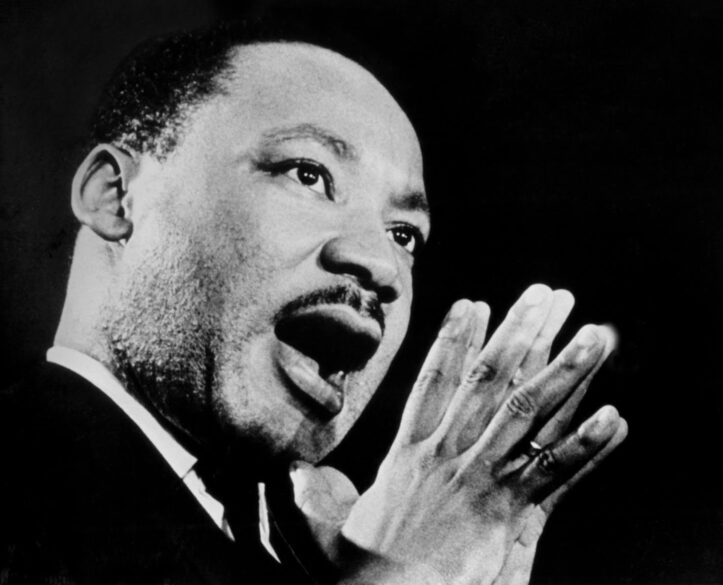
The Rev. Dr. Martin Luther King Jr. is pictured in an undated file photo. Rev. King was assassinated April 4, 1968, in Memphis, Tenn. Archbishop Timothy P. Broglio of the U.S. Archdiocese for the Military Services, president of the U.S. Conference of Catholic Bishops, reflected on Rev. King’s legacy in a Jan. 10, 2025, statement ahead of the Martin Luther King Jr. federal holiday, which is observed on the third Monday of January and which in 2025 takes place Jan. 20. (OSV News photo/CNS file)
Archbishop Timothy P. Broglio of the U.S. Archdiocese for the Military Services reflected on Rev. King’s legacy in a Jan. 10 statement ahead of the Martin Luther King Jr. federal holiday, which is observed on the third Monday of January and which this year is Jan. 20.
The commemoration was created after a 32-year-campaign to nationally recognize the life and work of Rev. King, a Baptist minister and Nobel Peace Prize winner who spearheaded the U.S. civil rights movement from the mid-1950s until his assassination in 1968. He was just 39 years old.
Profoundly influenced by the nonviolent approach of Indian activist Mahatma Gandhi, Rev. King led campaigns to end legal segregation of Black Americans in the U.S. in the face of at-times violent opposition.
Among the most celebrated of these efforts were the 1955-1956 Montgomery, Alabama, bus boycott; the 1963 March on Washington, which drew more than 200,000 demonstrators; and the 1965 march from Selma, Alabama, to that state’s capital in Montgomery.
Rev. King’s sermons, speeches and texts drew on his extensive theological training, and Archbishop Broglio opened his Jan. 9 statement with a quote from “Letter from a Birmingham Jail,” which Rev. King wrote following his April 1963 arrest for violating an Alabama law against mass public demonstrations. In the letter, Rev. King responded to fellow clergy members’ criticism of the civil rights campaign, declaring, “Injustice anywhere is a threat to justice everywhere.”
“In reflecting on the continuing realities of racial injustice, immigrant families seeking welcome, and economic disparity, these words remind us that we are connected and responsible for each other as we seek to fulfill the dream,” said Archbishop Broglio in his statement.
The archbishop also cited Pope Francis’ address to Congress during a 2015 apostolic visit to the U.S., in which the pope recalled King’s 1965 Selma-Montgomery march.
Echoing Rev. King’s 1963 “I Have a Dream” address in Washington, Pope Francis described the Selma-Montgomery march as part of King’s “campaign to fulfill his ‘dream’ of full civil and political rights for African Americans.”
“That dream continues to inspire us all,” the pope told Congress in 2015. “I am happy that America continues to be, for many, a land of ‘dreams.’ Dreams which lead to action, to participation, to commitment. Dreams which awaken what is deepest and truest in the life of a people.”
“Let us be inspired by this righteous man’s work and sacrifice to create a more just society for all of God’s children,” said Archbishop Broglio.
(Gina Christian is a multimedia reporter for OSV News. Follow her on X @GinaJesseReina.)
(Editor’s note: See reflections from two local Catholics on how Dr. King’s message impacted their lives.)
By OSV News Archbishop Gregory M. Aymond of New Orleans offered prayers for victims of what he described as a “sign of utter disrespect for human life” perpetrated by a man who drove a Ford pickup truck through crowds celebrating the New Year in New Orleans’ French Quarter around 3:15 a.m. Jan. 1. At least 15 people were reportedly killed, with around 35 others injured.
The driver was killed by police after leaving the vehicle and exchanging gunfire with law enforcement, striking two officers. The FBI is investigating the attack as an act of terrorism.
“Our prayers go out to those killed and injured in this morning’s horrific attack on Bourbon Street,” said Archbishop Aymond, a New Orleans native, in a Jan. 1 statement. “This violent act is a sign of utter disrespect for human life. I join with others in the Roman Catholic Archdiocese of New Orleans in offering prayerful support to the victims’ families. I give thanks for the heroic duty of hundreds of law enforcement and medical personnel in the face of such evil.”
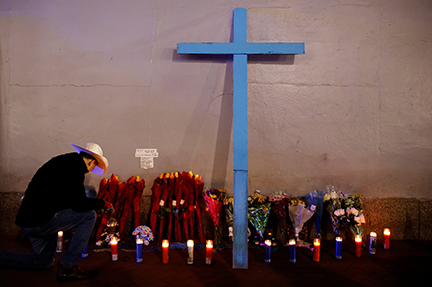
A man helps prepare a makeshift memorial in New Orleans Jan. 2, 2025, following a terrorist attack in which people were killed by a man driving a pickup truck into a crowd during New Year’s celebrations in New Orleans’ famed French Quarter early Jan. 1. At least 14 people were killed and dozens more were injured, and the suspect was shot to death by police, authorities said. (OSV News photo/Eduardo Munoz, Reuters)
Officials identified the driver as Shamsud-Din Jabbar, and said he likely did not act alone. An ISIS flag was located on the vehicle’s trailer hitch. The FBI found explosive devices in the pickup truck and elsewhere in the French Quarter, including reportedly near the historic Cathedral Basilica of St. Louis.
In an early afternoon press conference, officials described Jabbar, 42, as “a U.S.-born citizen from Texas” and U.S. Army veteran, and that law enforcement is looking for known associates. Anyone who had interacted with Jabbar within 72 hours prior to the attack is asked to contact the FBI at the agency’s tip line, 1-800-CALL-FBI. New Orleans Police Superintendent Anne Kirkpatrick and other city officials confirmed that the attack was deliberate and that they were focused on ensuring the safety of the city’s residents and visitors. Officials did not release information about the identities of the victims known dead. A few hours later, authorities updated the death count from 10 to 15.
Louisiana Attorney General Liz Murrill said during the press conference that there were “some people who are fighting for their lives right now in the hospital.”
“So I’d ask everyone to pray for them,” she said. “They need our support and they need our prayers. “This was a heinous act. A heinous, cowardly act,” she added. “And we will find them and we will bring them to justice.”
At the press conference, Louisiana Gov. Jeff Landry announced he had issued an amended emergency declaration so “that we could bring all of our federal, state, and local agencies to bear in preparation for the Super Bowl and Mardi Gras.” Because of the attack, Landry said he also ordered “the mobilization of a military police company” in New Orleans.
Also speaking at the press conference, U.S. Sen. John Kennedy said, “I wish I understood better why bad things happen to good people.”
“If I make it to heaven, I’m going to ask,” he said. “For those people who don’t believe in objective evil, all you have to do is look at what happened in our city early this morning. If this doesn’t trigger the gag reflex of every American, every fair-minded American, I’ll be very surprised.”
Kirkpatrick, whose role includes chief of police, called the action “evil” and that “New Orleans Police and all law enforcement is built, we are built, for dealing with evil.”
President Joe Biden said in a statement that he was “grateful for the brave and swift response of local law enforcement in preventing even greater death and injury.”
“I have directed my team to ensure every resource is available as federal, state, and local law enforcement work assiduously to get to the bottom of what happened as quickly as possible and to ensure that there is no remaining threat of any kind,” he said.
University of Notre Dame president Father Robert Dowd, a priest of the Congregation of Holy Cross, shared a message on a website for Notre Dame alumni and friends and on X, where he said the university community extends “our deepest gratitude to the brave first responders who risked their lives to protect others.”
“To be in solidarity with those who suffer is to exemplify the spirit of Notre Dame,” he wrote. “Today, we are in solidarity with all those impacted by this tragedy.”
Saying that it is “always grounded in faith, hope, and love, especially at difficult times,” the Cathedral Basilica of St. Louis posted on social media the archdiocese’s “Family Prayer” requesting the intercession of Mary under the title of “Our Lady of Prompt Succor.” It noted that the church “serves the entire Archdiocese and far beyond, but the French Quarter is our home and neighborhood.”
“We stand in solidarity with those who lost loved ones this morning,” it said. “We are grateful for the first responders and other healthcare and law enforcement professionals who put themselves in harm’s way and who care for the injured.”
The attack occurred on the solemnity of Mary, Mother of God, and the World Day of Peace.
By Richard Szczepanowski WASHINGTON (OSV News) – Hours after Cardinal Robert W. McElroy of San Diego was announced Jan. 6 as the new archbishop of Washington, the prelate praised his new archdiocese as “truly sacramental in the rich diversity of its traditions and perspectives.”
He also pledged to “show reverence for the grace of God which is already present in your midst and in the commitment to discipleship that underlies this local church.”
“I come as your bishop seeking to know and understand this magnificent community of faith,” Cardinal McElroy said. “As your pastor, an essential element of my mission is to encounter the hearts and the souls of the disciples who form our local church.”
In a virtual news conference at the Cathedral of St. Matthew the Apostle in Washington, Cardinal McElroy addressed his new flock via the Archdiocese of Washington’s YouTube channel because a major snowstorm shut down the city.
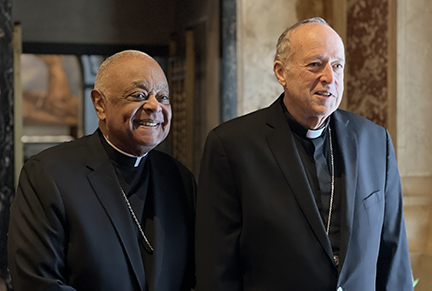
Washington Cardinal Wilton D. Gregory and Cardinal Robert W. McElroy leave a Jan. 6, 2025, news conference at the Cathedral of St. Matthew the Apostle in Washington. That morning, Pope Francis accepted the resignation of Cardinal Gregory, Washington’s archbishop since 2019, and named Cardinal McElroy of San Diego as his successor. As required by canon law, Cardinal Gregory submitted his resignation to the pope two years ago after he turned 75 on Dec. 7, 2022. (OSV News photo/Geoffrey Ros, Archdiocese of Washington)
“I want to give thanks to God for the grace-filled life of this local church and to Our Holy Father, Pope Francis who today makes me a member of that church,” Cardinal McElroy said.
Early Jan. 6, Pope Francis accepted the resignation of Cardinal Wilton D. Gregory, Washington’s archbishop since 2019, and named the San Diego prelate as his successor. As required by church law, Cardinal Gregory had submitted his resignation to the pope when he turned 75, which was two years ago, on Dec. 7, 2022.
The new archbishop of Washington said he has embraced Pope Francis’ emphasis on synodality and its call for the faithful to “build up a church centered in the Eucharist and devoted to the Word of God and the sacraments which sustain us.”
“Synodality calls us to walk humbly as a church, acknowledging our faults and sinfulness, and seeking forgiveness,” said Cardinal McElroy, who is 70. “It seeks the participation of every disciple in the church’s journey in this earthly pilgrimage, and is oriented toward the building of unity in society rooted in God’s justice, which cares especially for the unborn, the poor, the marginalized and the dispossessed.”
He said that in the Archdiocese of Washington, “for the past 85 years, the Catholic community has radiated the light of Christ throughout the District of Columbia and the surrounding five counties in Maryland.”
The archdiocese is home to more than 671,000 Catholics in D.C. and Maryland’s Montgomery, Prince George’s, St. Mary’s, Calvert and Charles counties.
Cardinal McElroy praised the archdiocese for its “rich parish communities of faith” and its “path-breaking development of lay ministries and apostolates, and the nurturing in lay leadership in the church that is genuinely participative and inclusive.”
The people of his new archdiocese, the cardinal said, are “men and women who form the people of God, struggling in a world filled with turbulence, hardship and illusion, to follow the pathway of Jesus Christ … (and are) called to be both dispensers and receivers of mercy and forgiveness.”
He noted that the Archdiocese of Washington has experienced “mountain-top moments” such as the visits of St. John Paul II, Pope Benedict XVI and Pope Francis and has endured “moments of failure and shame,” including reports of the sexual abuse of minors.
“In this mixture of the mountain top and failure, we are no different from the first disciples of the Lord,” Cardinal McElroy said. “It is to this community on the journey of faith that the Holy Father has called me to be bishop and pastor.”
Cardinal McElroy said Cardinal Gregory – appointed by Pope Francis in 2019 as the seventh archbishop of Washington and elevated to the College of Cardinals the following year – displayed “courage, a deeply pastoral heart and abiding faith in God and the dignity of the human person” as he “made critically important contributions at crucial moments in order to bring the Gospel of Jesus to the heart and the soul of the Catholic community here in Washington.”
At the Jan. 6 conference, Cardinal Gregory said, “As I reflect upon the past nearly six years in this wonderful local church of Washington, my heart is filled predominantly with joy and gratitude for the many blessings, always appreciated but rarely deserved that God has granted me.”
He thanked the priests, auxiliary bishops and the faithful, noting that “we have loved one another, cared for one another, challenged one another to be the Catholic Church Jesus Christ calls us to be.”
Cardinal Gregory said that he plans to remain in Washington after his retirement and serve where needed.
(Richard Szczepanowski is managing editor of the Catholic Standard, newspaper of the Archdiocese of Washington.)
The Catechism of the Catholic Church instructs, “The more prosperous nations are obliged, to the extent they are able, to welcome the foreigner in search of the security and the means of livelihood which he cannot find in his country of origin.”
At the same time, the church has also made clear human laws are also subject to divine limits. St. John Paul II’s 1993 encyclical “Veritatis Splendor” (“Splendor of Truth”) and 1995 encyclical “Evangelium Vitae” (“The Gospel of Life”) both quote the Second Vatican Council’s teaching in “Gaudium et Spes,” the Pastoral Constitution on the Church in the Modern World, which names “deportation” among various specific acts “offensive to human dignity” that “are a disgrace, and so long as they infect human civilization they contaminate those who inflict them more than those who suffer injustice, and they are a negation of the honor due to the Creator.”
The late pontiff underscored their moral severity in “Veritatis Splendor” by calling them examples of “intrinsic evil,” explaining that, no matter the motives, these acts are “not capable of being ordered to God and to the good of the person.”