SPIRITUAL ENRICHMENT CHATAWA – Our Lady of Hope, A Day of Hope and Healing with the Assumption of the Blessed Virgin Mary, Friday, Aug. 15 from 8 a.m. to 4 p.m. Enjoy talks by Father Patrick Gonyeau and Dr. Carol Razza, along with music, Mass, prayer, lunch and more. Details: register at www.OurLadyofHopeMS.com. Servants of the Sacred Heart of Jesus, Annual “Speak Lord I’m Listening” Retreat at Our Lady of Hope Retreat Center in Chatawa, July 25 at 7 p.m. through Sunday, July 27 at noon. Presenters Father Bill Henry and Jim Murphy will give techniques to pray and meditate on the scriptures. Cost: $350/person (includes all meals and private room); $275 for commuters. Details: contact Charlene at (601) 248-4310.
CLARKSDALE – St. Elizabeth, St. Faustina Relic Display and Presentation, Saturday, July 26. Event begins at 8:30 a.m. with breakfast followed by presentation by Jay Hastings, director of the Shrine of St. Faustine of The Divine Mercy in Memphis. He will lead prayer with first class relic of St. Faustina and speak about promises Jesus offers along with tools and avenues of grace from the Lord. Details: church office (662) 624-4301.
DIOCESE – Pastoral Ministries Workshop for parish leaders, Aug. 22-24 at Lake Tiak O’Khata in Louisville. Cost: $300/includes housing, meals and supplies. Details: email fran.lavelle@jacksondiocese.org.
GLUCKSTADT – St. Joseph, Millions of Monicas – Praying with confidence for our children, each Tuesday from 6:30-7:30 p.m. in the church. Join with other mothers and grandmothers as we pray for our children’s faithful return to the church. Details: email millionsofmonicas@stjosephgluckstadt.com.
JACKSON – St. Richard, ChristLife: Discovering Christ, begins Wednesday, Sept. 10 and ends Oct. 22 from 6:30-8:30 p.m. in Foley Hall. Retreat on Saturday, Oct. 11. Enjoy a delicious meal, listen to a dynamic teaching that helps people enter into or renew a personal relationship with Jesus Christ, experience the love of God the Father and be empowered by the Holy Spirit to live as God’s children and join in a small group discussion. Register at https://bit.ly/3HvRKGE. Details: call Tiffany at (601) 842-0151.
PARISH & YOUTH EVENTS GREENVILLE – St. Joseph, Vacation Bible School, July 27-29 from 5:15-7 p.m. in the parish hall. Event is for K3 through fifth graders. Details: register at stjosephgreenville.org or contact church office (662) 335-5251.
HERNANDO – Holy Spirit, Fall Bazaar, Sept. 13 from 9 a.m. to 3 p.m. Sales, silent auction, raffles and more. Details: email julieastefanik@gmail.com.
HOLLY SPRINGS – St. Joseph, Potluck Fundraiser, Saturday, July 26 at 6 p.m. Please bring a dish to share. All are welcome! Details: church office (662) 985-3209.
MERIDIAN – St. Patrick/St. Joseph, Youth Retreat, July 26 from 9 a.m. to 4 p.m. at Pine Lake Fellowship Camp. Retreat is for grades fifth through seniors. Enjoy games, food, fellowship and boating. Details: email Kristen at kaugustine@stpatrickcatholicschool.org.
OLIVE BRANCH – Queen of Peace, Taco Sunday, Aug. 10 after 10 a.m. Mass. Enjoy four tacos (carne asada or chicken) and a drink for $10. Details: church office (662) 895-5007.
Queen of Peace, Blood Drive, Sunday, July 27 from 9 a.m. to 12 p.m. Call 877-25-VITAL or visit donors.vitalant.org and use the code queenop to schedule your appointment.
SOUTHAVEN – Christ the King, Young Adults Fellowship Food and Fun Event, Tuesday, July 22 from 6:30-8 p.m. in the social hall. College age to mid 30s are welcome for a night of fellowship. Join us!
Christ the King, Cookie Social, Sunday, Aug. 3 after 11 a.m. and 12:30 p.m. Masses. Details: church office (662) 342-1073.
Por Madelyn Johnson JACKSON – Grayson Foley y EJ Martin, seminaristas de la Diócesis de Jackson que actualmente estudian en el Seminario Notre Dame de Nueva Orleans, planificaron su peregrinación a Italia con meses de antelación. Lo que no sabían era que su visita se convertiría en una experiencia única en la vida.
Los dos fueron llamados a unirse a la Peregrinación de la Esperanza por Roma. Después de reservar su viaje en febrero, se sorprendieron al saber que un nuevo papa, el papa León, había sido elegido el día antes de su vuelo a Roma.
CIUDAD DEL VATICANO – En la imagen superior, los seminaristas EJ Martin y Grayson Foley, de la diócesis de Jackson, aparecen entre los que participaron en la misa inaugural del papa León XIV en la plaza de San Pedro, en la Ciudad del Vaticano, el 18 de mayo de 2025. La histórica liturgia atrajo a más de 200.000 fieles, además de dignatarios, clérigos y peregrinos de todo el mundo. (Foto de Julia Mineeva/EGBN TV News/Alamy Live News/Alamy Stock Photo)
Durante su estancia en Roma, Grayson y EJ visitaron a otros seminaristas en el Pontificio Colegio Norteamericano y pasaron tiempo con el hermano mayor de EJ, Sterling Foley, seminarista de los Legionarios de Cristo con sede en su Casa de Formación en Roma. El trío recorrió la ciudad y visitó las cuatro basílicas principales, atravesando cada Puerta Santa durante este Año Jubilar.
“Atravesamos todas las Puertas Santas de las basílicas, rezando continuamente por la gente de nuestra tierra, Misisipi, y por aquellos que hicieron posible el viaje”, dijo Grayson Foley. Poco después de su llegada, se supo que la misa de investidura del papa León, el primer papa estadounidense, tendría lugar el 18 de mayo. Los seminaristas se enfrentaron a una decisión: ¿debían quedarse y servir en la histórica misa? La respuesta era clara: sí.
Gracias a la hospitalidad de los seminaristas legionarios de Cristo, se consiguieron entradas para EJ, Grayson y Grant Caillouet, un seminarista de la diócesis de Baton Rouge, para ayudar en la distribución de la comunión durante la misa de toma de posesión en la basílica de San Pedro. Asistieron casi 20.000 personas. Se sentaron a la derecha del altar y permanecieron allí hasta el Credo.
“Durante el Credo de la misa, nos llevaron a la capilla de adoración dentro de San Pedro”, recordó Grayson. “Cuando EJ y yo entramos en la gigantesca y vacía basílica de San Pedro, se estaba cantando la parte del Credo en la que se dice: ‘Et unam, sanctam, catholicam et apostolicam Ecclesiam’, que se traduce como ‘Y (creo en) una Iglesia santa, católica y apostólica’. La impresionante vista de la iglesia de San Pedro y lo fundamental que es ese lugar para la Iglesia me hizo llorar, pero tuve que contenerme porque estábamos a punto de distribuir la comunión”.
A cada seminarista se le dieron 100 hostias para distribuir entre los miles de asistentes a la histórica misa. Se adentraron entre la multitud gritando “¡Corpus Christi!” mientras daban la Eucaristía a los fieles. “EJ es alto y tiene los brazos largos, y distribuyó la comunión a tantas personas como pudo”, dijo su madre, Dana Martin, que presenció el evento a través de la retransmisión en directo. “Había barreras que retenían a la gente detrás del pasillo y EJ seguía abriéndose paso entre la multitud con la comunión: ¡Corpus Christi! ¡Corpus Christi! ¡Corpus Christi!”.
Desde la izquierda, los seminaristas EJ Martin y Grayson Foley, ambos de la Diócesis de Jackson, y Sterling Foley, de los Legionarios de Cristo, comparten un momento juntos en la Plaza de San Pedro en medio de la multitud. (Foto cortesía de Laura Foley)
Cuando terminaron de repartir las hostias, la multitud los separó. Grayson encontró el camino de vuelta al interior de San Pedro y fue testigo de cómo el papa León saludaba a dignatarios de todo el mundo, incluidos el rey y la reina de Francia.
EJ reflexionó: “Estar tan cerca de la toma de posesión del primer papa estadounidense fue increíble. Rezar con Jesús en mis manos en una basílica de San Pedro vacía fue increíble. Pero lo más increíble fue distribuir la comunión a la gente. Qué felices estaban de recibir a Jesús en esa misa. Probablemente, estas personas habían estado esperando más de cinco horas para tener esta oportunidad. Fue una experiencia tan bendita que nunca la olvidaré”.
Por Kate Scanlon WASHINGTON (OSV News) – El presidente Donald Trump firmó el 4 de julio un proyecto de ley de reconciliación fiscal que implementa gran parte de su agenda legislativa sobre impuestos e inmigración durante una ceremonia del Día de la Independencia en la Casa Blanca. “Nuestro país ha tenido mucho que celebrar este Día de la Independencia al entrar en nuestro 249.º aniversario. Estados Unidos está ganando, ganando, ganando como nunca antes”, declaró Trump en la ceremonia. “Hemos declarado oficialmente permanentes los recortes de impuestos de Trump”, añadió. “Es el mayor recorte de impuestos en la historia de nuestro país. … Después de que esto entre en vigor, nuestro país será un cohete, económicamente”. Previamente, la Cámara de Representantes de EE. UU. aprobó el 3 de julio la “One Big Beautiful Bill Act” (la Gran y Hermosa Ley) con una votación de 218 a 214. El Senado aprobó previamente el paquete de reconciliación el 1 de julio, después de que Trump los instara a hacerlo antes del 4 de julio.
Los líderes católicos han elogiado y criticado alternativamente diversas disposiciones de la legislación. Sin embargo, en una alerta de acción enviada por correo electrónico a sus partidarios el 1 de julio, la Conferencia de Obispos Católicos de EE.UU. finalmente declaró que el proyecto de ley “actualmente perjudica a las familias más pobres”. Solo dos republicanos – los representantes Thomas Massie, de Kentucky, y Brian Fitzpatrick, de Pensilvania – votaron en contra de la medida. Massie mencionó el aumento proyectado de la deuda nacional, mientras que Fitzpatrick, quien es católico, mencionó cómo los recortes a Medicaid afectarían a su distrito. El arzobispo Timothy P. Broglio, presidente de la USCCB y jefe de la Arquidiócesis de EE.UU. para los Servicios Militares, declaró el 3 de julio tras la votación que él y los obispos habían instado “repetida y consistentemente” a los legisladores a garantizar que el proyecto de ley ayudara a las familias necesitadas y a “cambiar de rumbo” en aspectos “que perjudican a los pobres y vulnerables”. “La versión final del proyecto de ley incluye recortes abusivos a la atención médica y la asistencia alimentaria, recortes de impuestos que aumentan la desigualdad, disposiciones migratorias que perjudican a familias y niños, y recortes a programas que protegen la creación de Dios”, declaró el arzobispo Broglio. “El proyecto de ley, tal como se aprobó, causará el mayor daño a las personas especialmente vulnerables de nuestra sociedad. Con la entrada en vigor de sus disposiciones, las personas perderán el acceso a la atención médica y tendrán dificultades para comprar alimentos, las familias se separarán y las comunidades vulnerables estarán menos preparadas para afrontar los impactos ambientales de la contaminación y las condiciones climáticas extremas”. El presidente de la USCCB afirmó: “Se debe hacer más para prevenir estos efectos devastadores”. Señaló que la propia enseñanza de la Iglesia sobre la dignidad humana y el bien común la obliga a “redoblar esfuerzos y ofrecer ayuda concreta a quienes más la necesiten, así como a seguir abogando por iniciativas legislativas que brinden mejores oportunidades en el futuro para quienes la necesiten”. El presidente de la Cámara de Representantes, Mike Johnson, republicano por Louisiana, declaró en una conferencia de prensa posterior a la votación que los republicanos “no querían desperdiciar la oportunidad” de controlar ambas cámaras del Congreso y la Casa Blanca para promulgar la agenda de Trump. “Muchas de las estimaciones sobre el impacto negativo que esta legislación tendría en las comunidades de mi estado o de cualquier otro son exageradas”, declaró Johnson al ser preguntado sobre las críticas al proyecto de ley por parte de grupos religiosos de su estado. “Les puedo asegurar que este proyecto de ley será muy beneficioso para todos en el país, especialmente para mis electores. Lo que es bueno para Louisiana es bueno para Estados Unidos”. Durante su discurso de ocho horas y 44 minutos en el pleno – parte de un procedimiento de la Cámara conocido como el “minuto mágico”, en el que los miembros del liderazgo pueden hablar todo el tiempo que deseen durante los discursos de “un minuto” sin restar tiempo extra al debate –, Jeffries dijo: “Me levanto hoy en firme oposición a la repugnante abominación de Donald Trump”. Jeffries afirmó que la legislación “destruye Medicaid, priva de comida a niños, ancianos y veteranos, y recompensa a los multimillonarios con enormes exenciones fiscales”. La Oficina de Presupuesto del Congreso, una entidad no partidista, estimó que casi 12 millones de personas perderán su cobertura médica bajo la legislación. Ingrid Delgado, directora nacional de políticas públicas y defensa de la Sociedad de San Vicente de Paúl EE.UU., declaró a OSV News: “Estos grandes recortes a la red de seguridad social son realmente preocupantes, por el impacto que tendrán en los más marginados”. “La Iglesia Católica considera el acceso a la alimentación y a la atención médica como derechos humanos fundamentales”, afirmó Delgado. “Por lo tanto, quienes acceden al SNAP en nuestro país y a Medicaid son nuestros hermanos y hermanas más marginados y pobres”. Delgado añadió que los recortes a estos programas podrían llevar a “más personas (a estar) sin seguro, sin comida y en riesgo de quedarse sin hogar”. La legislación aumentará significativamente los fondos para el Servicio de Inmigración y Control de Aduanas (ICE por sus siglas en inglés) y la Patrulla Fronteriza, mientras la administración Trump busca implementar sus políticas migratorias de línea dura, incluyendo la deportación masiva de inmigrantes sin autorización legal para vivir y trabajar en Estados Unidos. Autorizó cerca de 150 mil millones de dólares en nuevos gastos para inmigración y control fronterizo. Antes de la aprobación del proyecto de ley, el vicepresidente J.D. Vance promocionó el control migratorio como la razón principal por la que creía que los republicanos del Congreso debían aprobarlo. Sin embargo, otros celebraron una disposición de la legislación que retiraría fondos a Planned Parenthood solo por un año – en comparación con la propuesta original de 10 años – y la financiación se reanudaría posteriormente. Marjorie Dannenfelser, presidenta de Susan B. Anthony Pro-Life America, declaró a OSV News el día antes de la votación de la Cámara de Representantes que “este es el posible punto culminante del primer año en el que los contribuyentes federales no se ven obligados a financiar grandes abortos, y eso sería enorme”. En una campaña de recaudación de fondos en su sitio web, Planned Parenthood afirmó que el impacto de la legislación “será inmediato y devastador”. La Oficina de Presupuesto del Congreso, entidad no partidista, estimó que la legislación aumentaría el déficit en casi 3,3 billones de dólares entre 2025 y 2034. La deuda nacional de Estados Unidos asciende actualmente a 36,2 billones de dólares y tiene consecuencias para el resto de la sociedad. Una carta del 26 de junio dirigida a los senadores de la Conferencia de Obispos Católicos de Estados Unidos elogió la disposición que despojaría de fondos a Planned Parenthood, a la vez que se opuso a otras que, según ellos, aumentarían los impuestos a los trabajadores pobres y, al mismo tiempo, otorgarían grandes recortes fiscales a los más ricos. La carta añadía: “Por ello, millones de familias pobres no podrán permitirse una atención sanitaria que les salve la vida y tendrán dificultades para comprar alimentos para sus hijos. Algunos hospitales rurales probablemente cerrarán”. Los obispos calificaron estas disposiciones de “inconcebibles e inaceptables”. Ese mismo día, 20 obispos católicos estadounidenses firmaron una iniciativa interreligiosa que instaba al Senado a rechazar el proyecto de ley, citando, entre otras preocupaciones, los recortes a la asistencia nutricional y a Medicaid, y su impacto en los inmigrantes, calificándolo de “draconiano” y un “fracaso moral”.
(Kate Scanlon es reportera nacional de OSV News y cubre Washington. Síguela en @kgscanlon.)
Más información en Mississippi Catholic.com
Lee cómo 20 obispos de EE.UU. se unieron a un esfuerzo interreligioso que calificó la legislación como un “fracaso moral” en: http://bit.ly/46FXEPN
Para un análisis sobre cómo la ‘Gran y Hermosa Ley’ podría tener un impacto “sin precedentes” en los inmigrantes, visita: http://bit.ly/3Is31bf
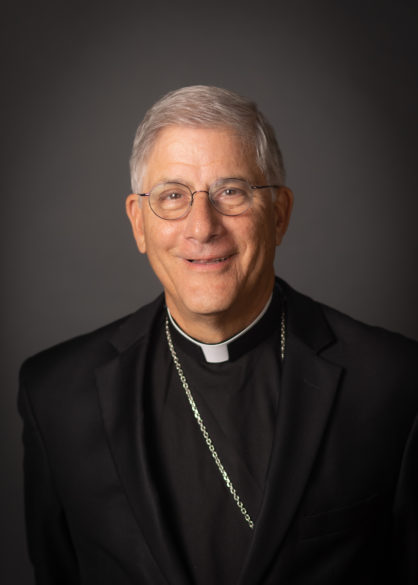
El obispo auxiliar de San Luis, Mark S. Rivituso, aparece en una foto de archivo. El 1 de julio de 2025, el papa León XIV aceptó la renuncia del arzobispo Thomas J. Rodi, de Mobile, Alabama, y nombró al ahora arzobispo Rivituso como su sucesor. (Foto cortesía de Rob Herbst/Arquidiócesis de Mobile)
JACKSON – El obispo Joseph R. Kopacz y la Diócesis de Jackson se regocijan en nombre de la Arquidiócesis de Mobile por el nombramiento por parte del papa León XIV del arzobispo Mark S. Rivituso como tercer arzobispo de Mobile. Es originario de la Arquidiócesis de St. Louis, donde ha ejercido como obispo auxiliar desde 2017.
Pedimos al Señor Jesús que le conceda sus mejores bendiciones durante este periodo de transición de San Luis a Mobile. Puede estar seguro de que recibirá una calurosa bienvenida a la provincia de Mobile como nuevo arzobispo.
Asimismo, elevamos nuestras oraciones de inmensa gratitud al arzobispo Thomas J. Rodi por su notable liderazgo como arzobispo de Mobile desde 2009 y, anteriormente, como obispo de Biloxi durante la catástrofe natural del Katrina. Ha sido verdaderamente un apóstol del Golfo como canciller y vicario general en Nueva Orleans, obispo de Biloxi y arzobispo de Mobile.
Que el Señor siga haciendo brillar su rostro sobre este buen y fiel servidor en su jubilación.
NACIÓN WASHINGTON (OSV News) – La Iglesia Católica “mantiene su postura de no apoyar ni oponerse a los candidatos políticos”, dijo la portavoz de la Conferencia de Obispos Católicos de EE.UU., Chieko Noguchi, a raíz de un reciente caso judicial en el que una prohibición federal de larga data contra tal actividad parecía haberse relajado parcialmente. Noguchi hizo esta declaración el 8 de julio, un día después de que el Servicio de Impuestos Internos (IRS por sus siglas en inglés) aceptara en un juicio que una casa de culto que hable a sus fieles de política electoral en el contexto de la fe religiosa no viola la Enmienda Johnson. Dicha disposición del código tributario de EE.UU. prohíbe a las organizaciones 501(c)(3) – un tipo de organización sin ánimo de lucro exenta de impuestos según el código tributario estadounidense, y la estructura corporativa típica de las iglesias, comunidades de culto y organizaciones benéficas del país – participar en actividades de campaña política. Sin embargo, dijo Noguchi, “El IRS estaba abordando un caso específico, y no cambia la forma en que la Iglesia Católica participa en el debate público”. Y añadió: “La Iglesia trata de ayudar a los católicos a formar su conciencia en el Evangelio para que puedan discernir qué candidatos y políticas promoverían el bien común”.
VATICANO CASTEL GANDOLFO, Italia (CNS) – Después de más de una década sin su veraneante más famoso, la tranquila ciudad de Castel Gandolfo vuelve a contar con el Papa entre sus residentes de verano. El Papa León XIV se convirtió en el decimosexto Papa en residir en la residencia papal de verano cuando se trasladó allí el 6 de julio, tras el rezo del Ángelus en la Plaza de San Pedro. “Esta tarde me trasladaré a Castel Gandolfo, donde pienso permanecer para un breve período de descanso”, dijo el Papa a los peregrinos reunidos en la plaza. “Deseo a todos que puedan disfrutar de un tiempo de vacaciones para reponer fuerzas físicas y espirituales”. La tradición de que los pontífices escapen del calor veraniego de Roma para trasladarse a las más frescas colinas de Alban comenzó con el papa Urbano VIII en 1626. En 2016, el Papa Francisco convirtió la propiedad papal en un museo, abriendo la villa y los jardines al público.
Manifestantes se unen a una marcha nocturna en Viotá, Colombia, el 26 de junio de 2025, con cientos de residentes portando velas y pancartas con fotos del padre Carlos Jaimes Guerrero. Durante casi tres semanas, las autoridades colombianas han estado buscando al fraile agustino de 30 años, desaparecido desde el 17 de junio, y aún no han identificado las posibles razones de su desaparición. (Foto de OSV News/página de Facebook del gobierno local)
MUNDO BOGOTÁ, Colombia (OSV News) – Las autoridades colombianas continuaron la búsqueda del padre Carlos Jaimes Guerrero, un sacerdote agustino de 30 años que desapareció el 17 de junio cerca de Viotá, al suroeste de Bogotá. Su camioneta fue encontrada abandonada más tarde, con el motor en marcha, sin signos de violencia y sin rastro alguno de él. Su familia ha pedido públicamente su liberación, y los lugareños han organizado vigilias y rezos. La búsqueda se produce en medio de la conmoción nacional por otra tragedia: el 1 de julio, las autoridades confirmaron que ocho misioneros evangélicos y protestantes, secuestrados en abril por disidentes de las FARC en Guaviare, fueron encontrados asesinados y enterrados en una fosa común. Las autoridades afirman que los guerrilleros atacaron al grupo para impedir que grupos rivales ganaran influencia. Los líderes eclesiásticos advierten que los grupos armados y los cárteles siguen aterrorizando a las comunidades y atacando especialmente a los líderes religiosos. Los agustinos piden oraciones y cooperación mientras se intensifica la investigación sobre la desaparición del padre Jaimes. «Las desapariciones siempre han formado parte de las graves violencias cometidas por los grupos armados aquí, incluidas las de personas religiosas», afirmó el teólogo Heyner Hernández Díaz. Destacó que los grupos guerrilleros y los cárteles de la droga se disputan territorios en muchas zonas de Colombia.
GREENVILLE – Sacred Heart parish RCIA candidates Quentin Nelson Sr., Alana Sorrell and Christian and Ashala Sorrell, pictured with Fathers Sebastian Myladiyil, SVD, and Tom Mullally, SVD. (Photo courtesy of parish)CARTHAGE – St. Anne Catholic Church celebrated its high school, college and university graduates on May 31.(Photo courtesy of parish)JACKSON – Holy Ghost parish held a Graduate Mass on May 25. Pictured are Dajia Williams, a graduate of Mississippi State University; Father Madanu Vijaya Bhaskar, SVD; and Kameron Fox, a graduate of Jim Hill High School. Not pictured: Hugh Smith and Earnestine Powell. (Photo by Dorothy Ashley)JACKSON – Christ the King graduates Kaitlyn deVerteuil, Sydney Asowata and Yann Tche were blessed by Deacon Denzil Lobo. (Photo by Maggie Spence)
VATICAN CITY (CNS) — Almost four years after Pope Francis opened the Catholic Church’s path toward synodality — a term many in the church had never heard before — his successor has thrown his support behind the last leg of the church’s synodal journey.
The Synod of Bishops, which admitted women, lay and other non-bishop voting members among its ranks during its two universal assemblies in October 2023 and 2024, “naturally retains its institutional profile and at the same time is enriched by the mature fruits of this season,” Pope Leo XIV told the ordinary council of the synod June 26. “You are the body appointed to reap these fruits and make a prospective reflection.”
Over two days, the council convened to approve a document for the synod’s final implementation stage intended to improve dialogue between local churches and the Vatican synod office, the General Secretariat for the Synod of Bishops said in a statement June 30. The document will be released July 7 at www.synod.va.
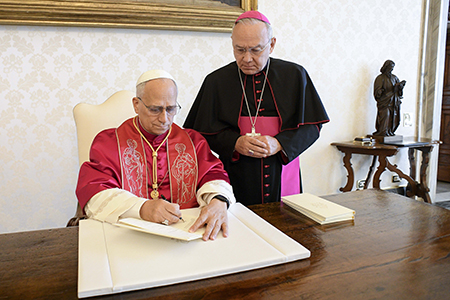
Pope Leo XIV addresses the Ordinary Council of the General Secretariat of the Synod during a meeting at the Vatican June 26, 2025. To the left of the pope is Bishop Luis Marín de San Martín, undersecretary of the synod. To the right are Cardinal Mario Grech, secretary-general, and Xavière Missionary Sister Nathalie Becquart, undersecretary. (CNS photo/Vatican Media)
The council also discussed the work of study groups instituted by Pope Francis to deal with hot-button topics — such as women’s ordination and changes to priestly formation.
The study groups were scheduled to present interim reports on their findings in June 2025, but the synod office noted that “due to the death of Pope Francis and the election of Pope Leo XIV, there have been delays.” In agreement with Pope Leo, the deadline to submit the final reports was extended to Dec. 31, 2025, and the interim reports will be published on the synod office’s website as they are received, it said.
According to the apostolic constitution “Universi Dominici Gregis,” which governs procedures when the papacy is vacant, a council or Synod of Bishops is immediately suspended when a pope dies or resigns. All meetings, decisions and promulgations must cease until a new pope explicitly orders their continuation, or they are considered null.
The late pope launched the diocesan phase of the worldwide synodal process in October 2021, and it was originally scheduled to culminate with an in-person assembly in Rome in October 2023. Another assembly was held after a year of listening in October 2024, and in March, Pope Francis launched a three-year implementation phase of the synod that will culminate in an ecclesial assembly at the Vatican in October 2028.
Pope Leo told the synod’s ordinary council June 26, “I encourage you in this work, I pray that it may be fruitful and as of now I am grateful.”
The General Secretariat of the Synod of Bishops said that the expected document, titled “Pathways for the Implementation Phase of the Synod,” is a practical and theological guide for diocesan bishops and synodal teams as they apply the synod’s final proposals locally.
The synod office noted that this phase of the synodal process “belongs above all to the local Churches,” which are tasked with translating the synod assembly’s “authoritative proposals” into concrete pastoral practices within their respective contexts. At the same time, the synod office said the guidelines were developed to respond to questions raised by bishops and diocesan leaders in recent months and are intended to support, not replace, local discernment.
Cardinal Mario Grech, secretary-general of the Synod of Bishops, acknowledged in his opening remarks of the council’s meeting that “difficulties and resistance” to the synodal process remain. He said that while some dioceses have already begun the implementation phase with enthusiasm, others are awaiting the forthcoming guidelines “with trepidation.”
“These contrary positions must not be overlooked,” he said. “Rather, I would say they must challenge us deeply.”
Cardinal Grech proposed establishing a permanent forum, which he called a “Table of Synodality,” to foster ongoing theological and canonical reflection on synodality and encouraged greater investment in formation programs. He also said that new partnerships with academic institutions and the continued support of young theologians would help cultivate a synodal “mentality” across the church.
(OSV News) — It’s a question with profound implications for millions of Americans: With the Trump administration’s “One Big Beautiful Bill Act” signed into law July 4, will families thrive or languish? Will poverty increase, or decrease? Will more go hungry, or will more be fed?
In a record-breaking eight-plus hours speech from the floor of the House, Democratic Minority Leader Hakeem Jeffries, D-N.Y. declared, “Republicans are trying to take a chainsaw to Social Security, a chain saw to Medicare, a chain saw to Medicaid, a chainsaw to the health care of the American people, a chain saw to nutritional assistance for hungry children, a chain saw to farm country, and a chainsaw to vulnerable Americans.”
Volunteer Walter Rogers, 83, helps Merrill Hancock, 87, load the groceries he received May 12, 2025, from the Eastside Community Ministry pantry in Zanesville, Ohio. The pantry is supplied by the Mid-Ohio Food Collective, a food bank that has long been part of the backbone of the nation’s anti-hunger system, channeling government support into meals. (OSV News photo/Evelyn Hockstein, Reuters)
After the bill passed, House Speaker Mike Johnson, R-La., rejected pessimistic evaluations.
“I think a lot of the estimations about what this legislation would do in a negative manner to communities, in my state or any other, are far overblown. I can tell you that this bill is going be a great thing for everybody around the country,” Johnson said. “I think they’re going to feel this pretty quickly. Wages will rise; I think household income will go up; I think the job participation rate will increase dramatically; I think unemployment will be low.”
“This is jet fuel for the economy,” concluded Johnson. “And all boats are going to rise.”
Given dueling political assessments, how should Catholics judge future outcomes of the One Big Beautiful Bill Act?
“A basic moral test,” the U.S. Conference of Catholic Bishops stated in its website resources concerning the impoverished, “is how our most vulnerable members are faring. In a society marred by deepening divisions between rich and poor, our tradition recalls the story of the Last Judgment (Mt 25:31-46) and instructs us to put the needs of the poor and vulnerable first.”
After the bill’s passage, Archbishop Timothy P. Broglio of the U.S. Archdiocese for the Military Services, president of the USCCB, issued a statement saying, “The bill, as passed, will cause the greatest harm to those who are especially vulnerable in our society.” He cited what he described as “unconscionable cuts to health care and food assistance, tax cuts that increase inequality, immigration provisions that harm families and children, and cuts to programs that protect God’s creation.”
The bill — estimated to cut $930 billion from Medicaid, $285 billion from Supplemental Nutrition Assistance Program, or SNAP — also increases the national debt on paper by $3.4 trillion, with interest pushing the bill closer to $4 trillion. According to a CATO Institute analysis of Congressional Budget Office numbers, President Donald Trump’s mass deportation campaign could add another $1 trillion to the debt by wiping out the predicted deficit reduction from 8.7 immigrants — including unauthorized, paroled, or asylum-seeker immigrants — that entered the U.S. during the Biden administration and have contributed to the economy.
“These cuts are going to have a staggering impact on the poor,” said John Berry, national president of the Society of St. Vincent de Paul USA, “and on people that are in the most desperate need.”
The Society of St. Vincent de Paul USA provides more than $1.7 billion in aid to more than 5 million people every year through person-to-person services, food pantries, disaster response, and more.
“There is no one that we’re supporting at this point that is not going to be negatively impacted by this bill,” Berry told OSV News. “Everybody that we serve is going to be hurt. Whether it’s the elderly, whether it’s the poor, whether it’s children — they’re all going to be hurt.”
Medicaid provides health coverage for 71.4 million Americans. New federal work rules and eligibility changes could pose complications for recipients. The bipartisan Congressional Budget Office earlier projected approximately 7.8 million people could become uninsured by 2034 due to the cuts.
Reductions in SNAP could impact 40 million people — including 16 million children, 8 million seniors and 4 million disabled adults — according to the Washington-based Center of Budget and Policy Priorities. The CBPP also projects that about 600,000 low-income households could find their SNAP benefits — formerly called “food stamps” — cut by an average of $100 per month.
Nearly 28 million adults nationwide — 12.5% of the adult population — live in homes where there was either sometimes or often not enough to eat in the previous week, according to 2023 data from the Census Bureau.
On June 27, Berry urged Congress to protect Medicaid and SNAP, acknowledging “the fiscal pressures that Congress and our nation must address. But we must also ask why the poor must suffer the most — and suffer they will.”
“The tax cuts that are being pushed through for people that don’t need them are being paid for by taking money away from the people that most desperately need it,” Berry said.
He also predicted a resulting rise in homelessness.
In 2024, the rate of homelessness was the highest since the U.S. Department of Housing and Urban Development in 2007 began keeping statistics.
Cuts to federal housing assistance, Berry predicted, are “only going to drive more people into homelessness because they are going to be forced into a situation where they have to decide between whether they’re going to pay their rent or take their medicines, pay their rent or eat, pay their rent or feed their kids.
“And those totally unacceptable decisions,” he said, “are going to drive more and more people into the street.”
Given the extent of federal and state reductions, nonprofits are not prepared to cover the resulting gaps, Berry advised.
The density of the bill — 1,118 pages for the House version, 870 pages in the Senate — was enough to confound even the most politically inquisitive.
“There is so much in the One Big Beautiful Bill Act,” said Lelaine Bigelow, executive director of the Georgetown Center for Poverty and Inequality. “And everyday Americans really don’t have time to focus on the thousands of little provisions that are in there.”
For those who are overwhelmed, Bigelow offered a summary.
“The core thing that I would tell people about this bill is that this is a transfer from things to help people in their everyday lives, like tax credits, and SNAP, and Medicaid,” she told OSV News.
“It is the largest wealth transfer we’ve ever seen in this country — and the transfer is going from the poorest to the richest,” she added.
When asked if poverty, hunger and illness are likely to increase in America, Bigelow didn’t hesitate.
“Absolutely,” she said. “We will see people lose health care. We will see people go hungry. We will also see mental health deteriorate.”
Still, the idea that such a fate only awaits someone else has perhaps reassured those who nonetheless may be impacted.
“A lot of people think, ‘This won’t affect me’ or ‘I’m not really going to see these cuts,'” Bigelow said. “But this is actually about the people in your community. It’s about the people that you’re going to church with, the kids that you see on your son’s soccer team.”
As to states or nonprofits stepping up to fill the gap, Bigelow, too, is skeptical.
“There’s a reason why we have these federal government programs — and I think being lost in this, is that they work really well. SNAP is one of the most effective tools to prevent hunger in America, and Medicaid provides health coverage to 71 million people,” she said. “States can’t operate on that same scale.”
Bigelow is dismissive of those who propose that the bill’s large tax cuts for Americans with greater levels of wealth will eventually help the poor.
“Trickle-down economics is not the way you build this country,” she said. “That is not what works. It’s not how we eliminate poverty.”
Prior to the House and Senate passing their versions of the measure, the USCCB directed a letter to each respective chamber of Congress, “both to commend certain important provisions, but also strongly to urge reconsideration of provisions that will harm the poor and disadvantaged.”
There are some family-friendly provisions in the Senate version of the bill — such as temporary tax breaks for tip income, overtime pay and interest on auto loans; a permanent increase in the full child tax credit (for families with qualifying dependent children) starting in 2025; a $1,000 “Trump account” for babies; and a temporary deduction (through 2028) for tax filers age 65 and older.
“At a general level, the beneficiaries of Medicaid disproportionately tend to be family households,” Lyman Stone, a senior fellow at the Institute for Family Studies, told OSV News. “And so cuts to Medicaid have a tendency to be cuts to family households. And so that section of the bill could create some difficulties for families as they think about having children.”
As to the expansion of the child tax credit, Stone explained that owing to inflation, anything less than $2,500 is effectively a cut in the credit.
Even so, an increase in this tax credit won’t help 17 million children whose low-income families don’t earn enough to claim the full credit.
Stone wasn’t thoroughly convinced about the newborn “Trump accounts,” either.
“I think the Trump accounts are very unlikely to do much to help families. Handing an 18-year- old $1,000 — maybe by that point, it’s $2,000, $3,000 — I don’t think that’s going to make a radical difference in their life, to be honest,” he suggested. “So it’s a pleasant gesture, but I’m not clear on how it’s supposed to really benefit these families.”
“On the whole,” observed Stone, “I think that the bill probably cuts slightly more money from families than it gets back in other programs.”
He paused, reflecting.
“Some people will have new positive incentives. Some people have new negative ones,” he said. “But I think it’s mostly just going to kind of shuffle things around — and not have a big impact one way or another on family formation.”
(Kimberley Heatherington writes for OSV News from Virginia.)